The Land Before Time (1988)1: Go to reference 1 at the end of the page played a huge role in sparking my early love of dinosaurs. Born in the early ’80s, this movie was made for my generation, and it absolutely hit the mark with me. It was one of the few VHS tapes2: Go to reference 2 at the end of the page I owned, since most of what we watched back then was either rented or recorded off of TV, and I watched it constantly. To this day, I still find myself quoting “You wait for Petrie?” at least once a month.
I loved the whole gang: Petrie, Ducky, Spike, and Cera. But I had a soft spot for Littlefoot, the main protagonist, a young Brontosaurus, or at least, that’s what we called him back then, before the whole “Brontosaurus isn’t real, oh wait, yes it is” debate.3: Go to reference 3 at the end of the page He lost his mother while she was protecting him from Sharptooth, a fearsome T. Rex, and set off on a journey to find his grandparents in the Great Valley.

 Brontosaurus by Nobu Tamura is licensed under CC BY-SA 4.0.
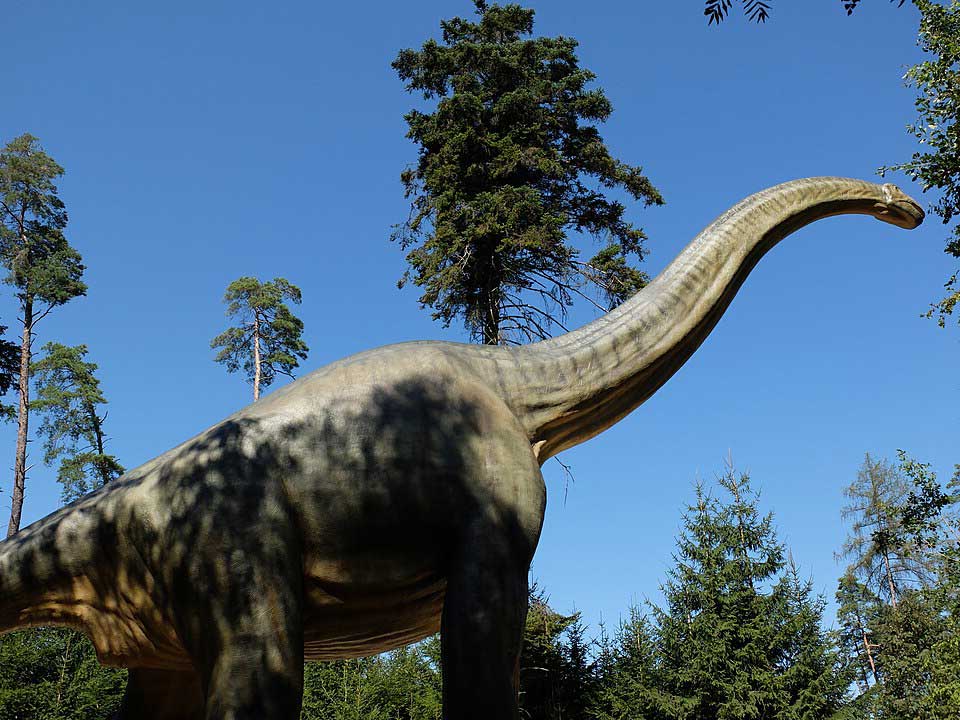 Brachiosaurus by Christian-wittmann-1964 is licensed under CC BY-SA 4.0.
A childhood fascination with Brontosaurus grew into a broader fascination with all sauropods.4: Go to reference 4 at the end of the page As most dinosaur fans grow older, they begin to realise just how diverse these creatures truly were. The Mesozoic5: Go to reference 5 at the end of the page spanned tens of millions of years, with countless species evolving to fill different ecological niches.
While all sauropods were plant-eaters, that doesn’t mean they all ate the same thing. It’s easy to assume their long necks were used only to reach the tallest trees, and that’s true for some, but not all. Thanks to modern technology, palaeontologists can now study fossil evidence more closely to determine what kinds of plants different sauropods ate.6: Go to reference 6 at the end of the page It turns out their diets were quite varied.
With dozens of species spanning over 100 million years, I wanted to learn more about these ancient titans. So, I decided to dig deeper and expand my knowledge. Some of the better-known species, like Brontosaurus7: Go to reference 7 at the end of the page and Diplodocus,8: Go to reference 8 at the end of the page were already around by the Jurassic period, but how far back do they really go? Were there Triassic sauropods? Where did the earliest species come from?
Sauropods and theropods,9: Go to reference 9 at the end of the page the bipedal meat-eaters like T. Rex and Spinosaurus, were both part of the saurischian group,10: Go to reference 10 at the end of the page which stands apart from the other major branch of dinosaurs, the ornithischians.11: Go to reference 11 at the end of the page
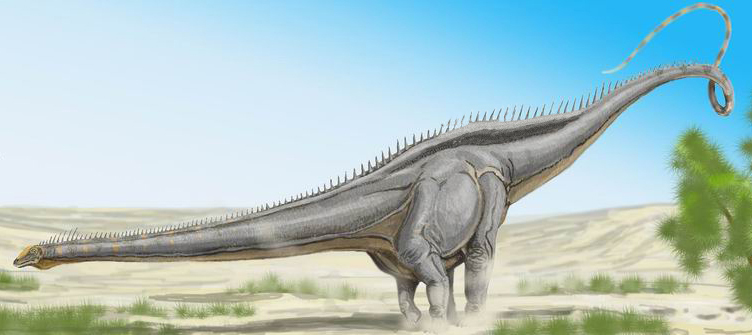 Seismosaurus by ДиБгд is licensed under public domain.

Origins and Evolution
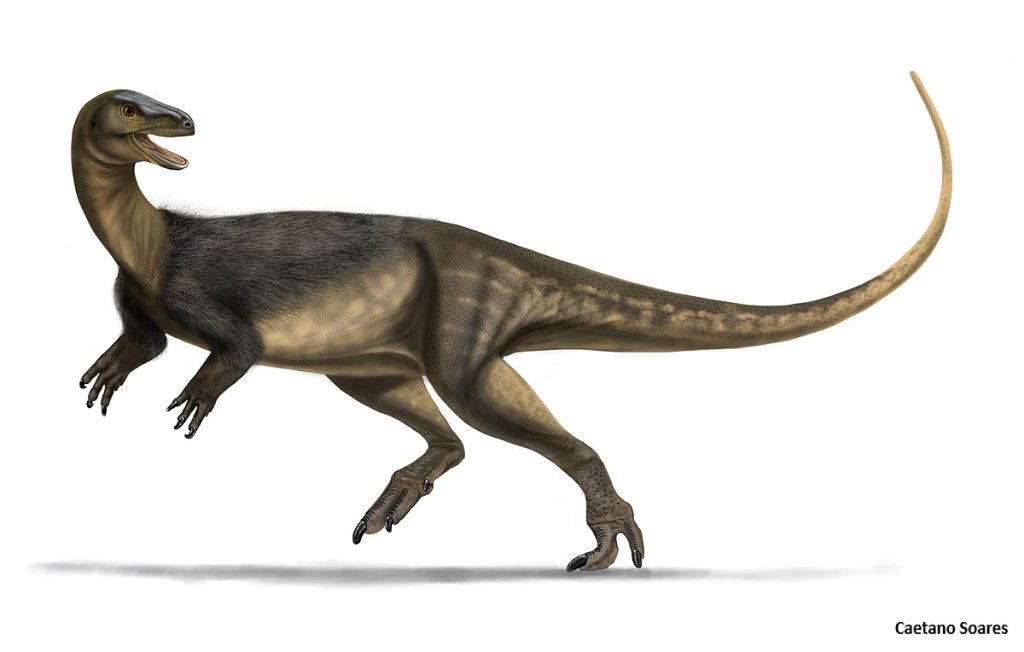 Saturnalia tupiniquim by CaetaMS is licensed under CC BY-SA 4.0.
The earliest sauropods trace their origins to the Late Triassic period, around 200 to 230 million years ago. They evolved from smaller bipedal ancestors known as sauropodomorphs,13: Go to reference 13 at the end of the page which already showed traits that would define true sauropods, including long necks, herbivorous diets, and relatively lightweight skulls. As these early forms grew larger and more specialised, they gradually shifted to a fully quadrupedal stance, giving rise to the first true sauropods.14: Go to reference 14 at the end of the page
This evolutionary shift brought major changes to their skeletons. Their limbs became more column-like to support increasing body size, their necks lengthened further to reach high vegetation, and their digestive systems adapted for processing large amounts of plant matter. These changes marked the beginning of the classic sauropod body plan.15: Go to reference 15 at the end of the page
The earliest sauropodomorphs, and possibly the earliest true sauropods, appear to have originated in southern Pangaea,16: Go to reference 16 at the end of the page especially in what is now South America. Basal forms such as Chromogisaurus17: Go to reference 17 at the end of the page and Panphagia18: Go to reference 18 at the end of the page from Argentina’s Ischigualasto Formation19: Go to reference 19 at the end of the page date to approximately 231.4 million years ago, while Saturnalia20: Go to reference 20 at the end of the page from Brazil’s Santa Maria Formation21: Go to reference 21 at the end of the page is dated to about 233 million years ago. These species are among the oldest known dinosaurs.
One of the oldest candidate sauropods, Isanosaurus,22: Go to reference 22 at the end of the page was discovered in Thailand and originally dated to about 210 million years ago. Later studies have questioned that estimate, with some research suggesting an Early or possibly Late Jurassic age.23: Go to reference 23 at the end of the page This uncertainty makes it unclear whether Isanosaurus truly represents one of the earliest sauropods.

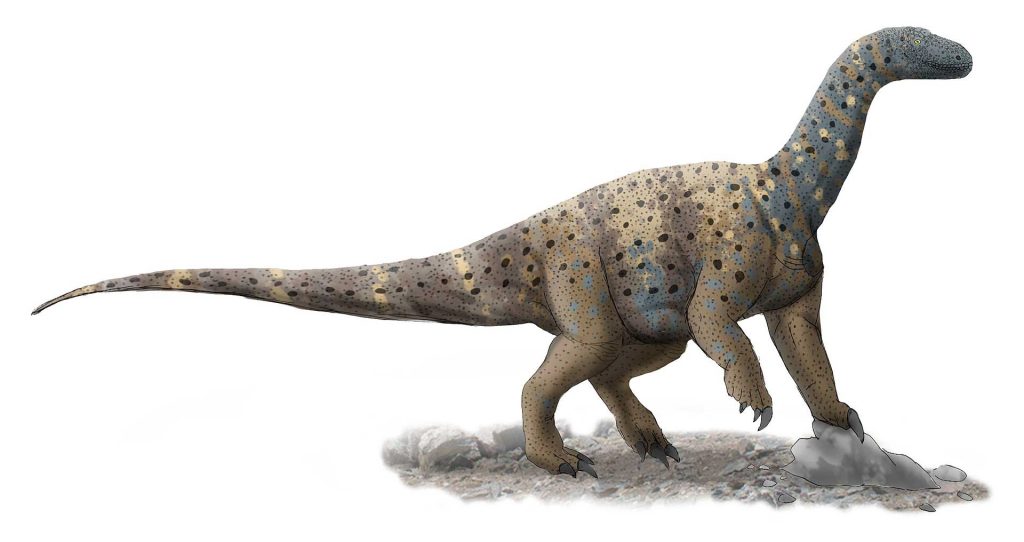 Antetonitrus by PaleoEquii is licensed under CC BY-SA 4.0.
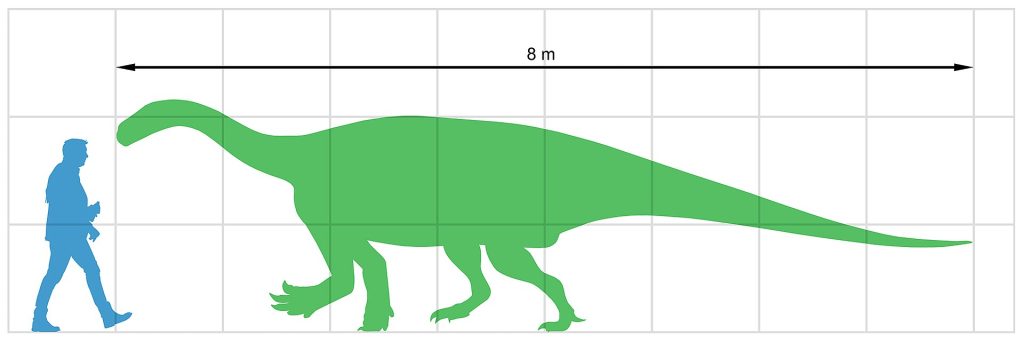 Antetonitrus size by Megalotitan is licensed under CC BY-SA 4.0.
Antetonitrus24: Go to reference 24 at the end of the page is a key transitional dinosaur in sauropod evolution. Discovered in South Africa’s Elliot Formation, it lived during the Early Jurassic around 201 to 190 million years ago. Positioned between the smaller, more agile sauropodomorphs and the colossal, fully quadrupedal sauropods, it bridges a crucial gap in the fossil record. Its name, Antetonitrus, means “before the thunder,” a reference to its place in time before sauropods such as Brontosaurus.25: Go to reference 25 at the end of the page Although it retained primitive features like a grasping thumb and flexible forelimbs, it also began to show the elongated neck and weight-supporting limb adaptations characteristic of true sauropods.26: Go to reference 26 at the end of the page
What makes Antetonitrus particularly significant is its insight into the early shift toward quadrupedalism. Its forelimbs were robust and relatively longer than those of its predecessors, traits that suggest it walked on all fours most of the time.27: Go to reference 27 at the end of the page At the same time, it kept grasping capabilities in its hand, unlike later sauropods whose wrists became rigid, weight-bearing structures. These intermediate characteristics highlight how sauropods gradually transitioned toward supporting massive body sizes with columnar limbs.28: Go to reference 28 at the end of the page
Lessemsaurus29: Go to reference 29 at the end of the page was a large early sauropodiform dinosaur from the Late Triassic of Argentina, living during the Norian stage around 210 million years ago. Named in honor of science writer Don Lessem, it stood out as one of the earliest dinosaurs to approach massive body size and exhibit skeletal adaptations that foreshadow later sauropods. Adult specimens are estimated to have reached lengths of approximately 9 to 10 meters and weighed around 7,000 kg.30: Go to reference 30 at the end of the page Its anatomy included an expanded torso, reinforced vertebrae, and robust limb bones, structural traits suited for supporting substantial weight.31: Go to reference 31 at the end of the page Although some degree of bipedal movement was still possible, its anatomical proportions suggest a shift toward increased quadrupedalism. Lessemsaurus’s morphology represents a pivotal point in the evolutionary experimentation toward gigantism and efficient herbivory in early dinosaurs.
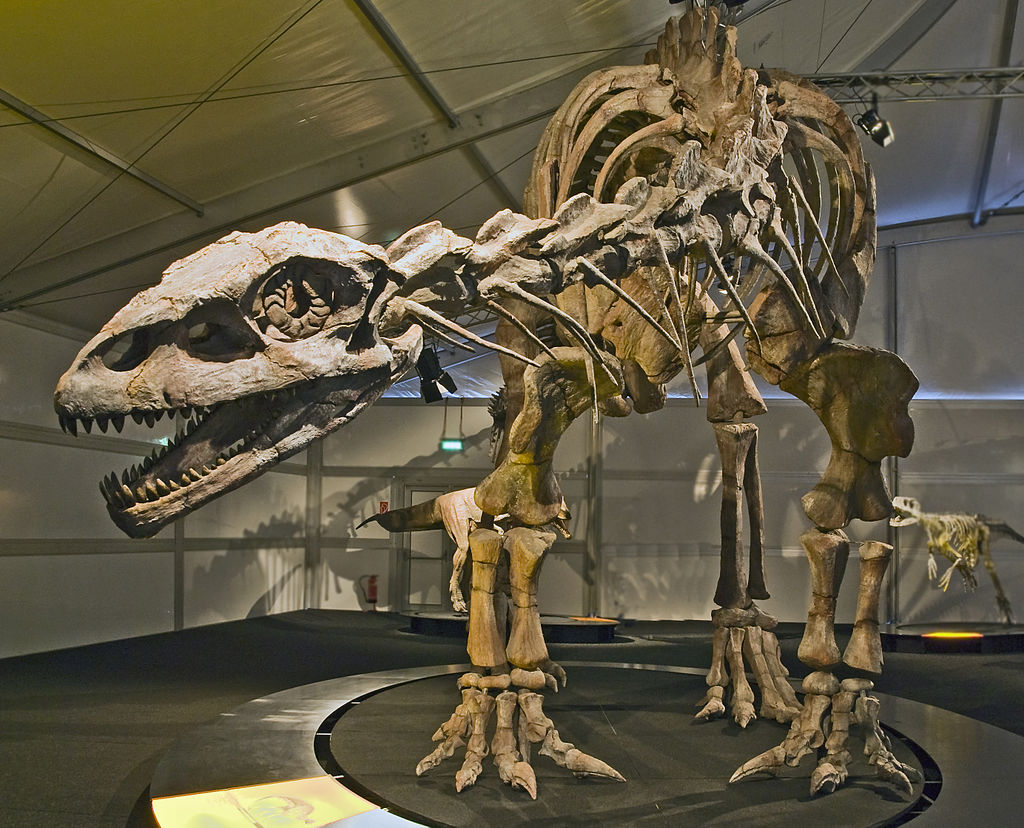 Lessemsaurus Senckenberg by Katharina Surhoff is licensed under CC BY-NC-ND 3.0.
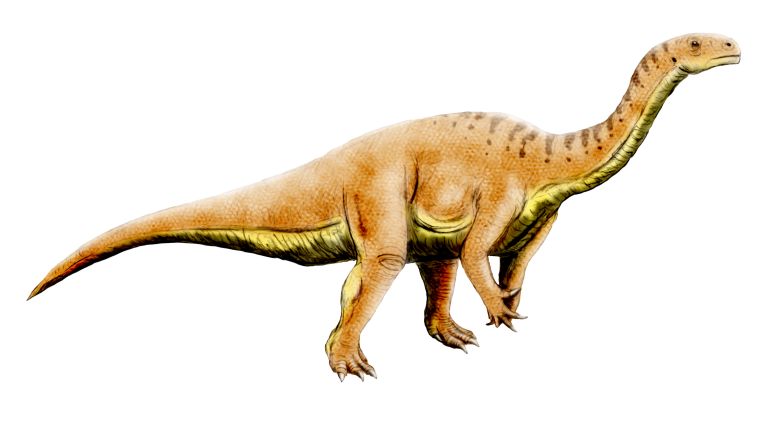 Leonerasaurus by Nobu Tamura is licensed under CC BY-SA 3.0.
Leonerasaurus taquetrensis32: Go to reference 32 at the end of the page was a small sauropodomorph dinosaur from the Early Jurassic, approximately 190 million years ago, discovered in the Las Leoneras Formation of central Patagonia, Argentina. This species measured about 2.5 meters in length and weighed roughly 70 kilograms. Despite its modest size, Leonerasaurus is significant for its combination of primitive and advanced traits, offering insights into the evolutionary transition toward true sauropods. Notably, its dentition features spoon-shaped anterior teeth and leaf-shaped posterior teeth, a pattern also observed in early sauropodomorphs like Mussaurus and Melanorosaurus. Additionally, the vertebrae of Leonerasaurus exhibit a mix of basal and derived characteristics, indicating a complex evolutionary pathway.33: Go to reference 33 at the end of the page
This mosaic of features underscores that sauropod evolution was not a straightforward progression but involved overlapping stages and regional diversity. Leonerasaurus exemplifies how Early Jurassic South America served as a hub for evolutionary experimentation among sauropodomorphs, paving the way for the emergence of fully developed sauropods.
Vulcanodon34: Go to reference 34 at the end of the page is one of the earliest known true sauropods, dating to the Early Jurassic period, approximately 190 million years ago. Discovered in 1969 on a small island in Lake Kariba, Zimbabwe, it was formally described in 1972 by paleontologist Michael Raath. The genus name, Vulcanodon, combines “Vulcanus” (Roman god of fire) and “odon” (tooth), referencing the fossil’s discovery near volcanic rock and its distinctive knife-shaped teeth, which were later identified as belonging to a theropod.
Known from a partial skeleton, including parts of the pelvis, hind limbs, and tail, Vulcanodon exhibited clear adaptations to a fully quadrupedal lifestyle. Its forelimbs were about three-quarters the length of its hind limbs, suggesting a horizontal posture suitable for ground-dwelling herbivory. While not perfectly adapted to quadrupedalism, its limb proportions indicate a significant step toward the giant body plan characteristic of later sauropods.35: Go to reference 35 at the end of the page
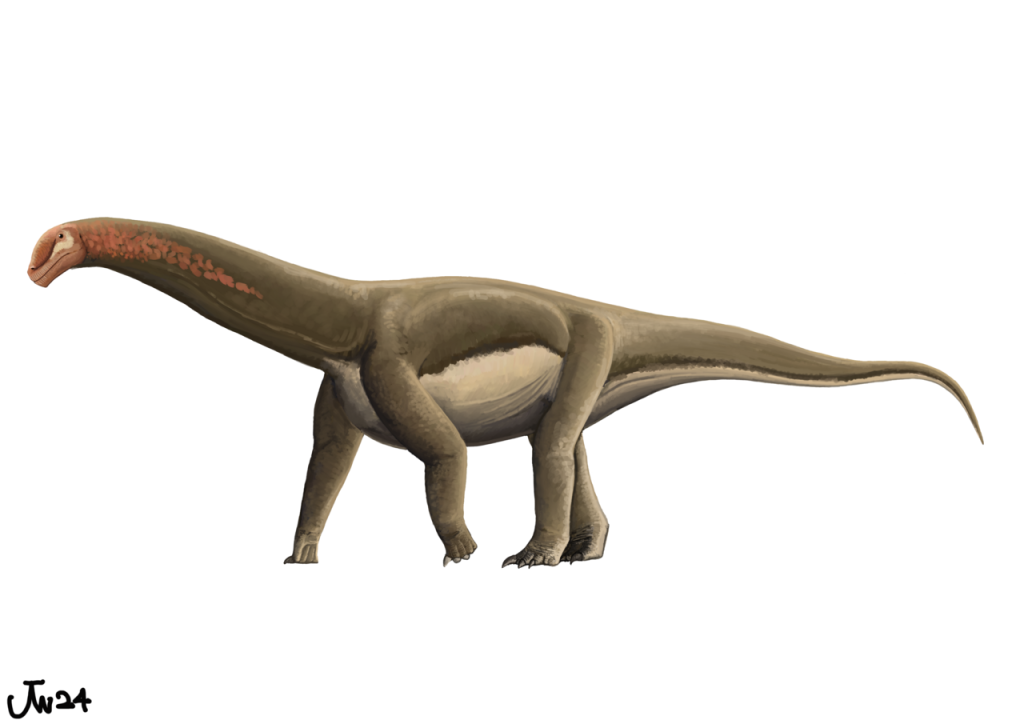 Vulcanodon by J-H. Jang is licensed under CC BY-SA 4.0.
Vulcanodon holds particular significance for understanding sauropod evolution. It retained some primitive features, such as relatively simple teeth and unfused vertebrae, yet its overall form clearly belongs within true Sauropoda. Its discovery helped confirm that early sauropods had already adapted to a fully quadrupedal, herbivorous lifestyle by the start of the Jurassic. Additionally, it supports the idea that sauropods had a wide geographic range early in their history, appearing in Africa not long after their likely origin in South America or southern Pangaea.36: Go to reference 36 at the end of the page
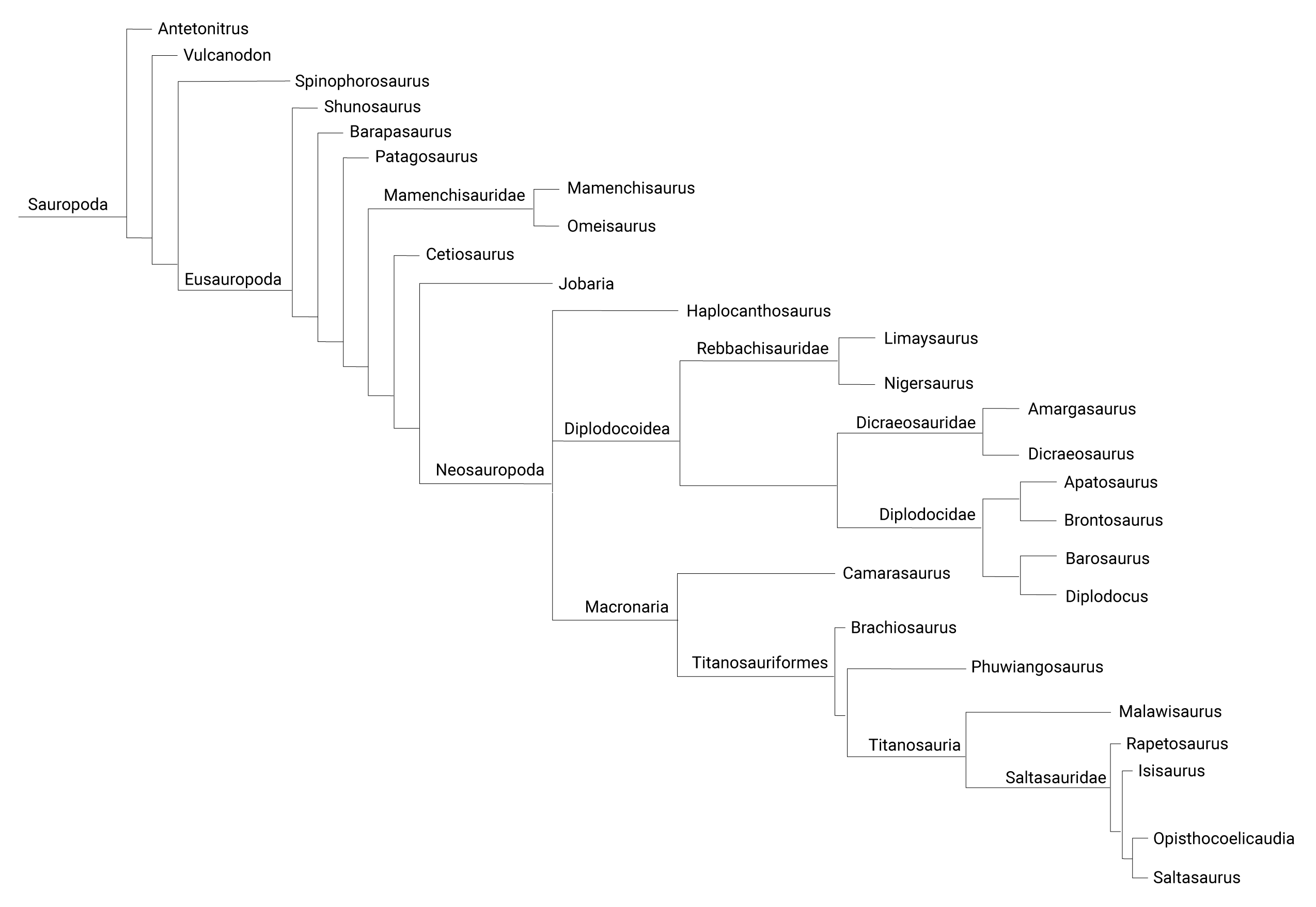
Text description of image
Cladogram showing evolutionary relationships between sauropod species.
Antetonitrus appears as the most basal (earliest branching) sauropod in this tree.
Vulcanodon branches off next, still representing an early sauropod lineage.
The tree then splits into two major groups:
Upper Branch (Eusauropoda):
- Spinophorosaurus branches off first within Eusauropoda
- Shunosaurus follows
- Barapasaurus comes next
- Patagosaurus branches off
- The Mamenchisauridae clade contains:
- Mamenchisaurus
- Omeisaurus
Lower Branch (Major Sauropod Radiation):
- Cetiosaurus represents an early branch
- Jobaria branches off next
- Neosauropoda then splits into two major lineages:
- Diplodocoidea (Left Neosauropod Branch):
- Haplocanthosaurus at the baseRebbachisauridae containing:
- LimaysaurusNigersaurus
- AmargasaurusDicraeosaurus
- ApatosaurusBrontosaurusBarosaurusDiplodocus
- Camarasaurus at the base of Macronaria
- Titanosauriformes containing:
- Brachiosaurus
- Phuwiangosaurus
- Titanosauria which includes:
- Malawisaurus
- Saltasauridae containing:
- Rapetosaurus
- Isisaurus
- Opisthocoelicaudia
- Saltasaurus
- Haplocanthosaurus at the baseRebbachisauridae containing:
- Diplodocoidea (Left Neosauropod Branch):
This cladogram shows the major evolutionary split between the more primitive sauropods and the derived Neosauropoda, with Neosauropoda further dividing into the long-necked, whip-tailed Diplodocoidea and the typically larger, more robust Macronaria (which includes the giant Titanosauria).
Giants of Land and Forest
By the Middle to Late Jurassic, sauropods had become the undisputed giants of the land. They roamed in large herds, occupied a variety of habitats, and had diversified into several distinct lineages.37: Go to reference 37 at the end of the page Some, such as the diplodocids, swept their long necks close to the ground to graze on ferns and horsetails. Others, like the brachiosaurids, reached for the highest branches. There were also unusual forms adapted to specific environments, from floodplains rich in cycads to open woodlands dotted with conifers, each thriving through different feeding strategies and body shapes.38: Go to reference 38 at the end of the page
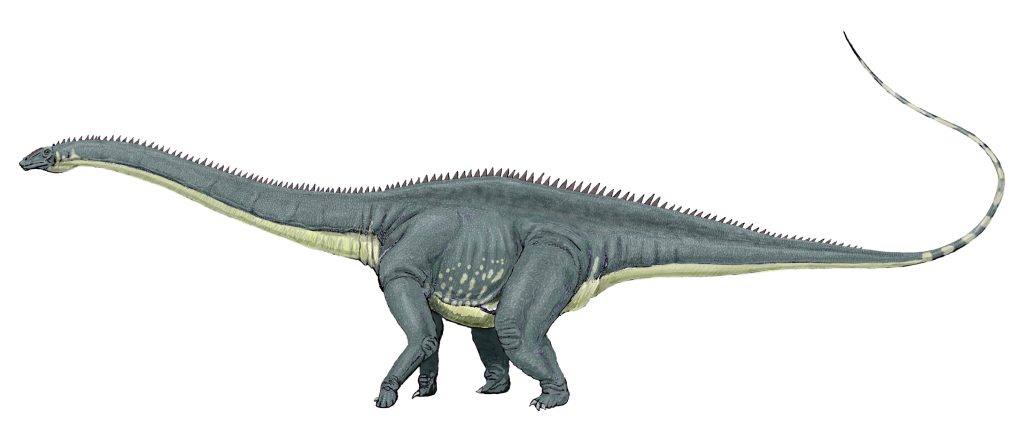 Diplodocus longus by Dmitry Bogdanov is licensed under CC BY 3.0.
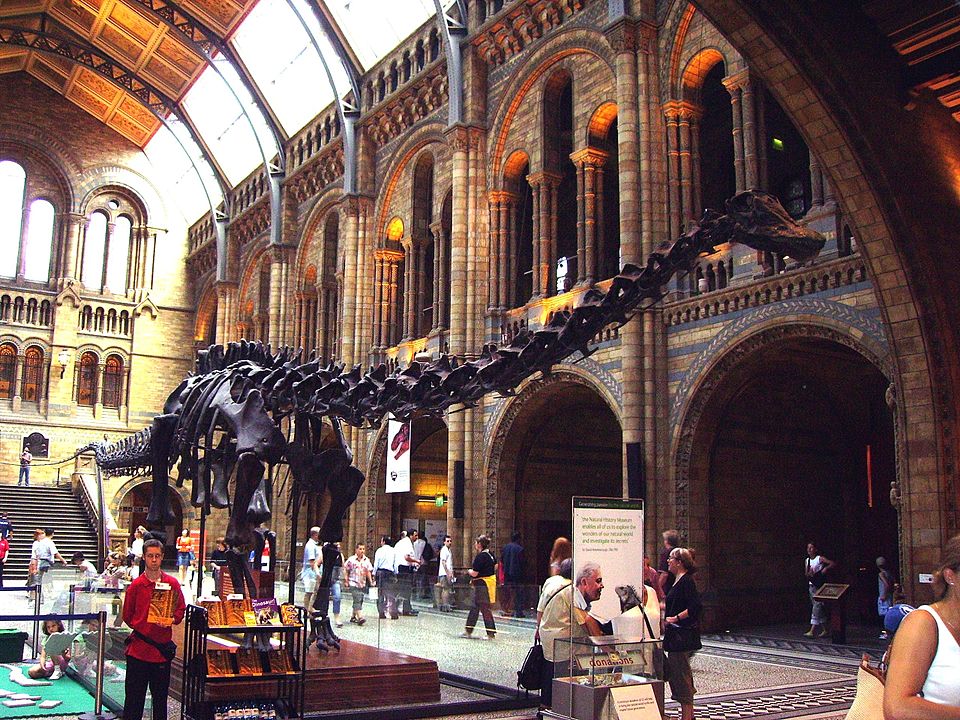 Diplodocus NHM by Ballista is licensed under CC BY-SA 3.0.
Diplodocids39: Go to reference 39 at the end of the page were among the most recognisable sauropods of the Late Jurassic, famous for their exceptionally long necks and tails. Species such as Diplodocus40: Go to reference 40 at the end of the page, Apatosaurus41: Go to reference 41 at the end of the page, and Brontosaurus42: Go to reference 42 at the end of the page thrived in what is now North America, particularly within the fossil-rich Morrison Formation. Their necks were held mostly horizontally, allowing them to sweep back and forth to feed over a wide area without moving their massive bodies. This posture supported a low-browsing lifestyle, feeding primarily on ferns, horsetails, and cycads. Their tails were equally remarkable, tapering into thin, whip-like tips that may have been used for defence, social display, or generating loud cracks to deter predators.43: Go to reference 43 at the end of the page
Some diplodocids were among the longest animals to ever walk the Earth. Diplodocus hallorum may have exceeded 30 metres in length, with over half of that length comprised by its neck and tail.44: Go to reference 44 at the end of the page Despite their immense size, diplodocids were relatively lightly built, with hollow bones that reduced weight and a narrow, low-slung body that helped maintain balance. Their teeth were small and peg-shaped, concentrated at the front of the jaws, ideal for stripping leaves rather than chewing. This meant they swallowed vegetation whole and relied on massive digestive systems to process it. Fossil trackways suggest that diplodocids may have lived and travelled in herds, providing protection for juveniles against large predators such as Allosaurus.
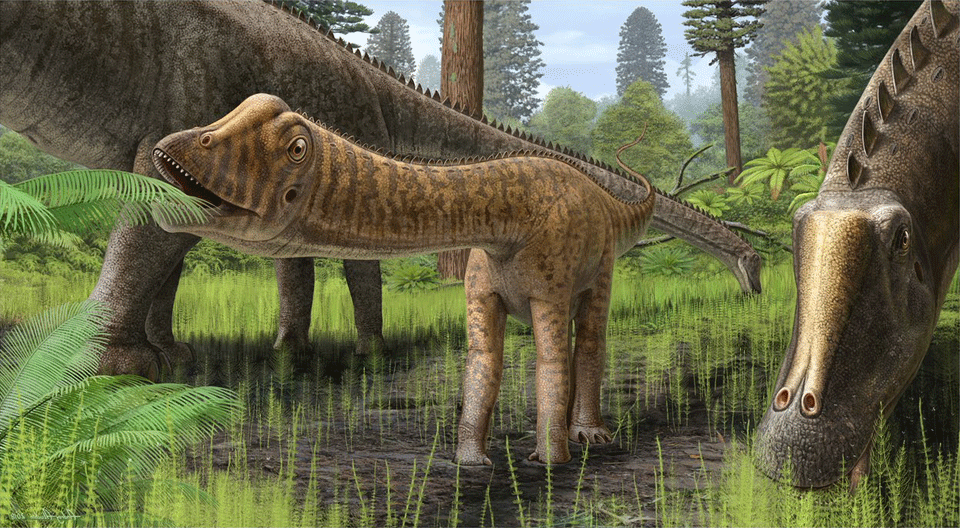 Smallest Diplodocid by A. Atuchin is licensed under CC BY 4.0.
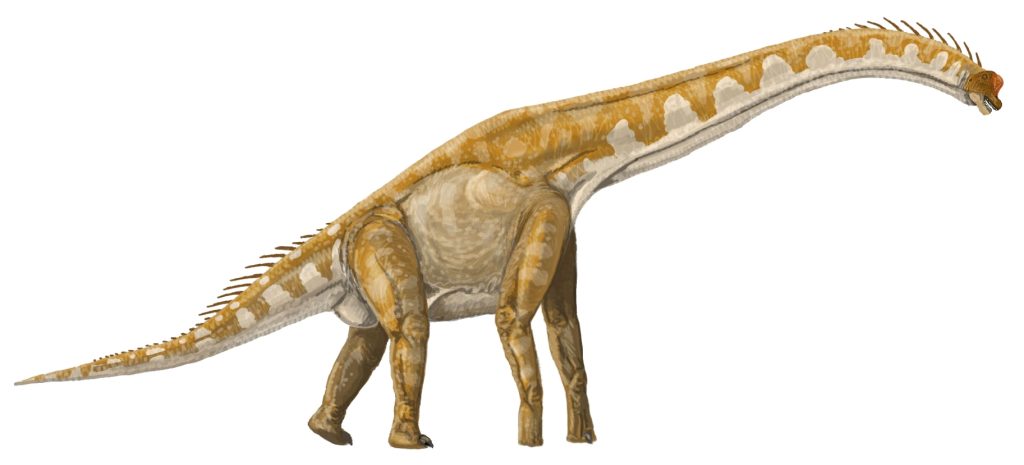 Giraffatitan by Dmitry Bogdanov is in the public domain.
Brachiosaurids46: Go to reference 46 at the end of the page followed a very different strategy. With long forelimbs and an upward-sloping body, they could browse from the tops of the tallest trees. Genera such as Brachiosaurus47: Go to reference 47 at the end of the page in North America and Giraffatitan48: Go to reference 48 at the end of the page in Africa towered over other herbivores in their ecosystems. Their necks were held more vertically, allowing them to reach leaves that other sauropods could not. This gave them access to a largely untapped food source, reducing competition with low and mid-level browsers. Their large nostrils were placed high on the head, once leading scientists to believe they lived partly in water, although this idea has since been dismissed in favour of a fully terrestrial lifestyle.
These towering browsers had massive, barrel-shaped bodies to house the enormous digestive systems needed for their leafy diet. Their teeth were spoon-shaped, well-suited for stripping foliage from branches. The combination of long forelimbs, high neck posture, and robust skeleton made them among the heaviest land animals to ever exist, with some estimates suggesting weights over 50 tonnes.49: Go to reference 49 at the end of the page Like diplodocids, they would have needed vast quantities of food each day, likely feeding for many hours. The differences in body design and feeding height between brachiosaurids and diplodocids show how multiple giant herbivores could thrive in the same environment without directly competing for the same plants.50: Go to reference 50 at the end of the page
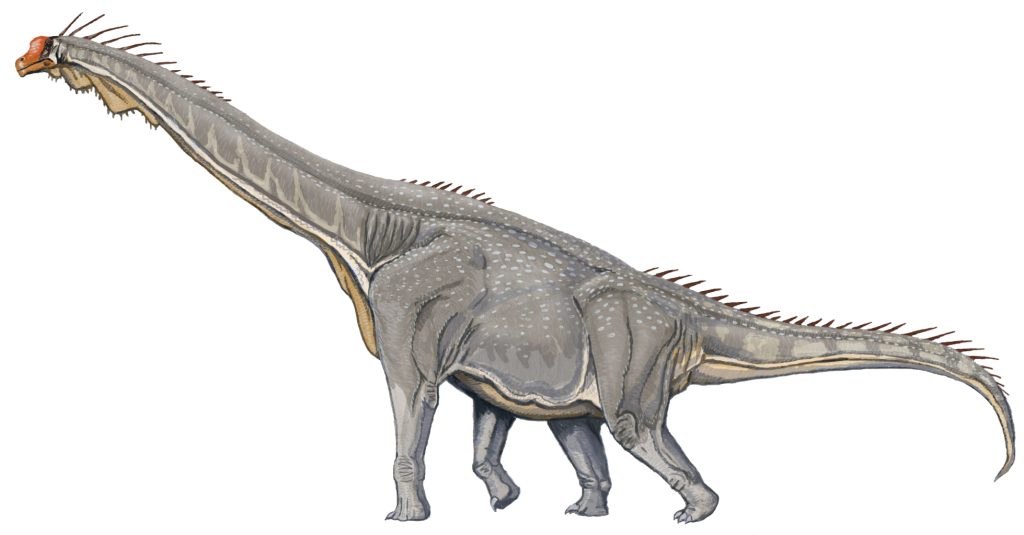 Brachiosaurus by Dmitry Bogdanov is in the public domain.
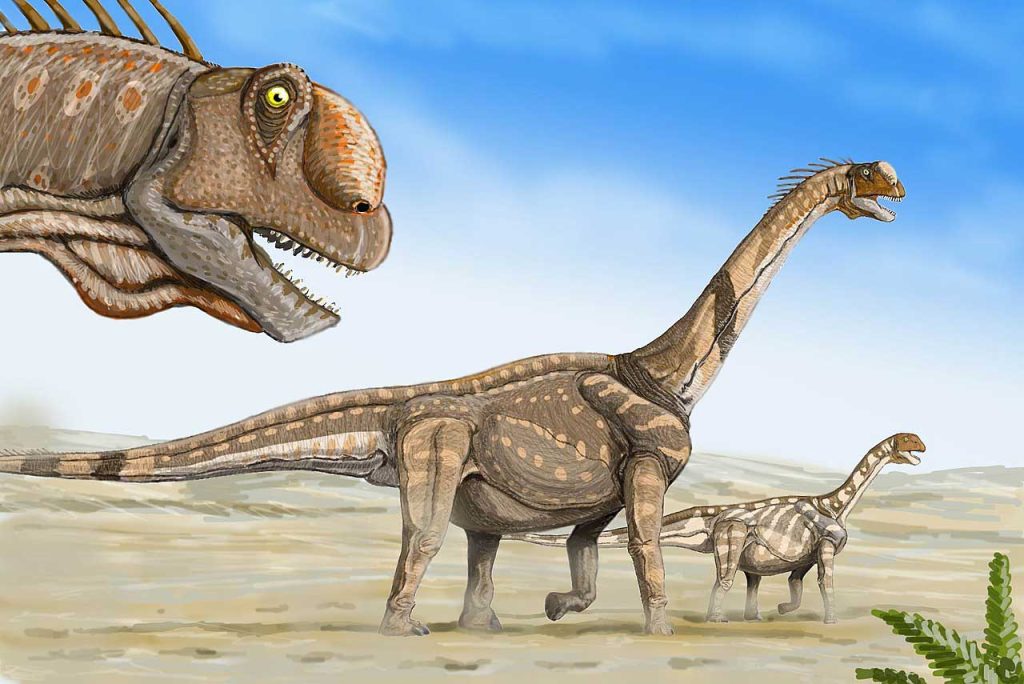 Camarasaurs by Dmitry Bogdanov is licensed under CC BY 3.0.
Macronarians52: Go to reference 52 at the end of the page were another major branch of sauropods that began to flourish in the Late Jurassic. They included medium- to large-sized forms such as Camarasaurus,53: Go to reference 53 at the end of the page which was one of the most common sauropods in the Morrison Formation. Camarasaurus had a shorter neck and deeper skull than diplodocids, with strong spoon-shaped teeth that allowed it to feed on tougher plant material, including cycads and conifer branches.54: Go to reference 54 at the end of the page Its anatomy suggests it was a mid-height browser, able to reach vegetation that diplodocids could not, but without competing directly with the high-browsing brachiosaurids. This middle feeding zone gave macronarians a valuable niche in sauropod-rich environments, and their sturdy build made them well adapted to a variety of habitats.55: Go to reference 55 at the end of the page
While many macronarians were not as massive as the brachiosaurids, they were often more compact and powerfully built, with sturdy limbs and shorter tails. This gave them stability on uneven terrain and may have allowed them to move more efficiently between feeding areas. Fossil evidence from trackways suggests that some species may have preferred smaller group sizes compared to the huge herds of diplodocids, possibly reflecting differences in their feeding range or social structure. Their versatility in both diet and habitat helped them thrive alongside other giants, making them an important and stable presence in Late Jurassic ecosystems.
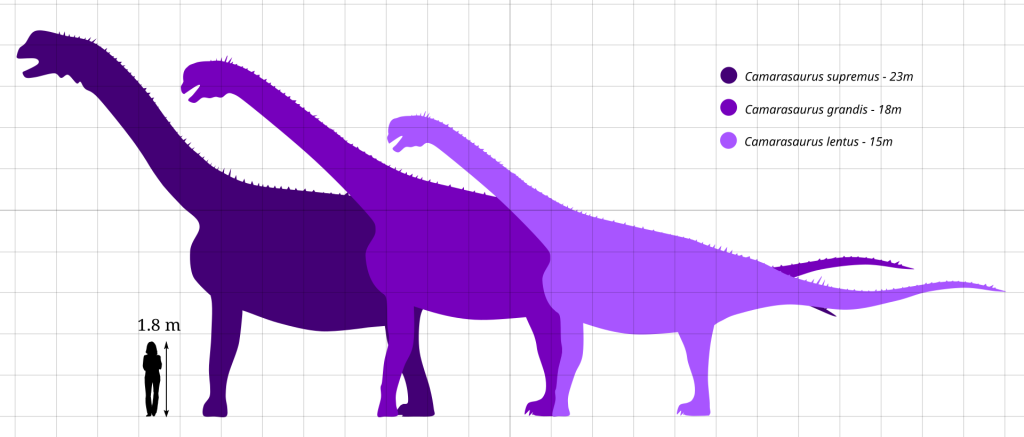 Camarasaurus Size Comparison by Paleo Geek Squared is licensed under CC BY-SA 4.0.
Titans of the Cretaceous
By the start of the Cretaceous period, sauropod diversity had narrowed compared to their Jurassic heyday. Many of the great lineages, including the diplodocids and brachiosaurids, had disappeared by the end of the Early Cretaceous, likely due to changes in climate, vegetation, and competition from other herbivores. In their place, one branch of macronarians rose to dominance, the titanosaurs.56: Go to reference 56 at the end of the page These adaptable giants spread across nearly every continent, from South America and Africa to Europe, Asia, and even Antarctica. They were the last surviving sauropods, thriving in environments ranging from arid inland plains to lush coastal floodplains, and they would carry the sauropod legacy all the way to the end of the age of dinosaurs.
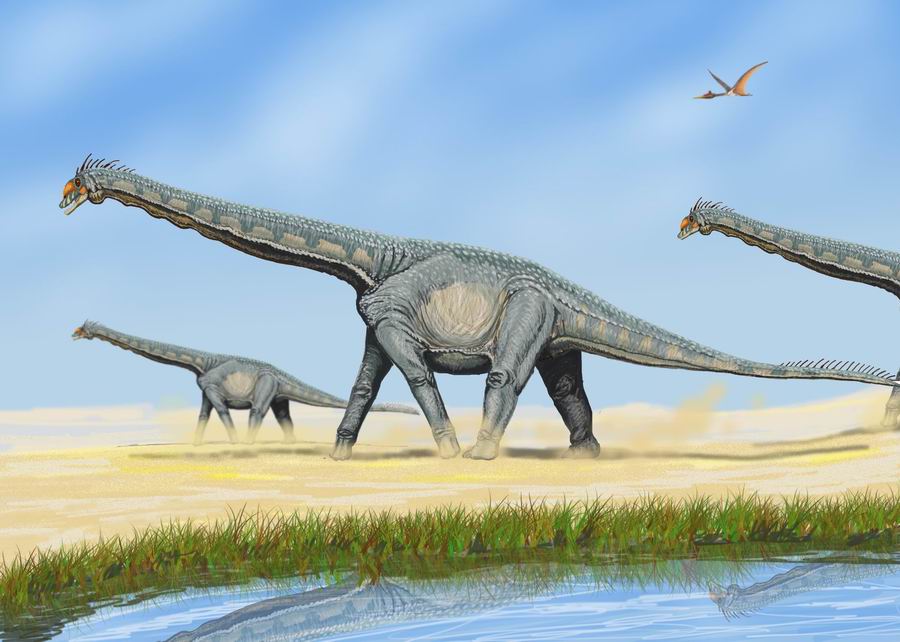 Alamosaurus by Dmitry Bogdanov is licensed under CC BY-SA 3.0.
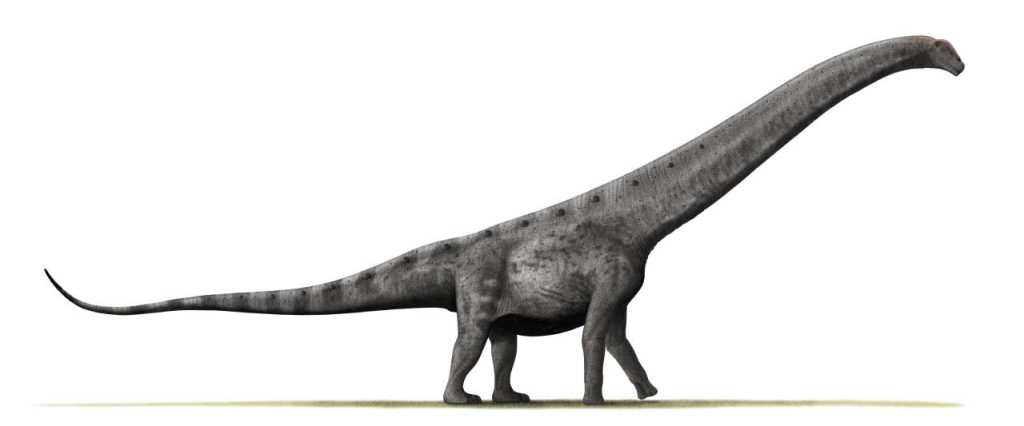 Argentinosaurus by Nobu Tamura is licensed under CC BY 3.0.
Argentinosaurus57: Go to reference 57 at the end of the page is often considered the largest land animal to have ever lived, with estimates placing it at over 30 metres long and weighing perhaps 60 to 70 tonnes. It lived during the Late Cretaceous, around 94 million years ago, in what is now Argentina. The fossil evidence is fragmentary, consisting mainly of vertebrae, ribs, and parts of the limb bones, but even these few bones are massive, with some vertebrae measuring over 1.5 metres tall.58: Go to reference 58 at the end of the page
Its enormous size likely made it almost invulnerable to predators once fully grown, though juveniles may have been at risk from large theropods such as Mapusaurus.59: Go to reference 59 at the end of the page Despite its fame, much about Argentinosaurus remains a mystery, including its exact body proportions and posture, but it stands as a powerful symbol of the extremes reached by titanosaurs during the Cretaceous.
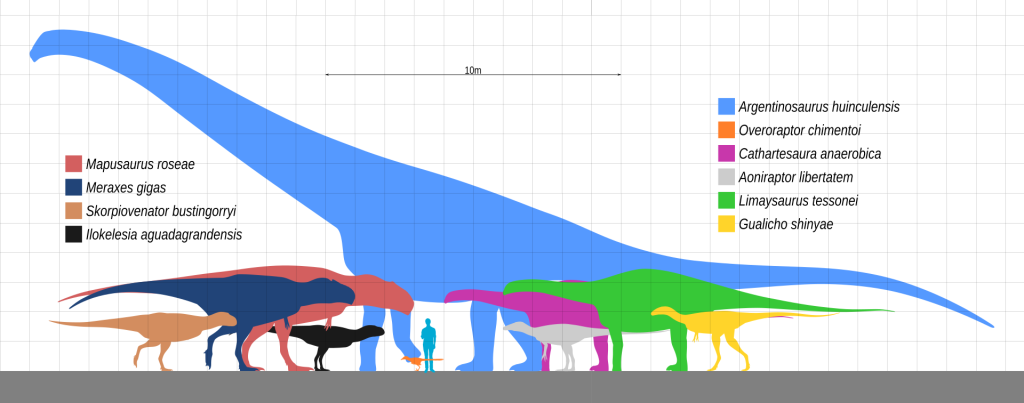 Huincul Formation Dinosauria Scale by Slate Weasel is in the public domain.
Text description of image
A graphic depicting the comparative scale of dinosaurs from the Huincul Formation.
Mapusaurus roseae (red) Meraxes gigas (navy blue) Skorpiovenator bustingorryi (brownish orange) Ilokelesia aguadagrandensis (black) Argentinosaurus huinculensis (light blue) Overoraptor chimentoi (orange) Cathartesaura anaerobica (magenta) Aoniraptor libertatem (grey) Limaysaurus tessonei (green) Gualicho shinyae (yellow)
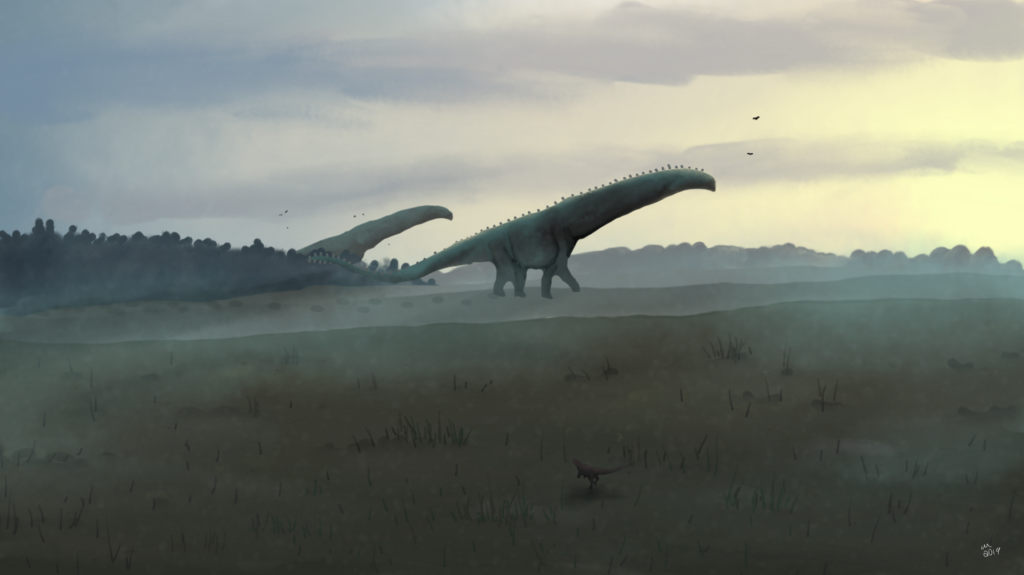 Patagotitan at dawn by PaleoEquii is licensed under CC BY-SA 4.0.
Patagotitan60: Go to reference 60 at the end of the page is another contender for the title of largest dinosaur, and unlike Argentinosaurus, it is known from a far more complete set of fossils. Discovered in the Chubut Province of Argentina and dating to around 101 million years ago, this titanosaur is represented by multiple individuals, providing scientists with an unusually detailed look at its anatomy. Estimates suggest it reached about 31 metres in length and weighed around 55 to 60 tonnes.61: Go to reference 61 at the end of the page
Its massive limb bones, some over two metres long, show the sheer scale of its build, while its broad hips and strong, column-like legs supported a heavy, muscular body. The abundance of remains at the site has also given palaeontologists valuable insights into titanosaur growth, biomechanics, and how such giants moved through their Cretaceous landscapes.62: Go to reference 62 at the end of the page The discovery of Patagotitan reinforced Argentina’s status as one of the world’s richest sources for colossal sauropods.
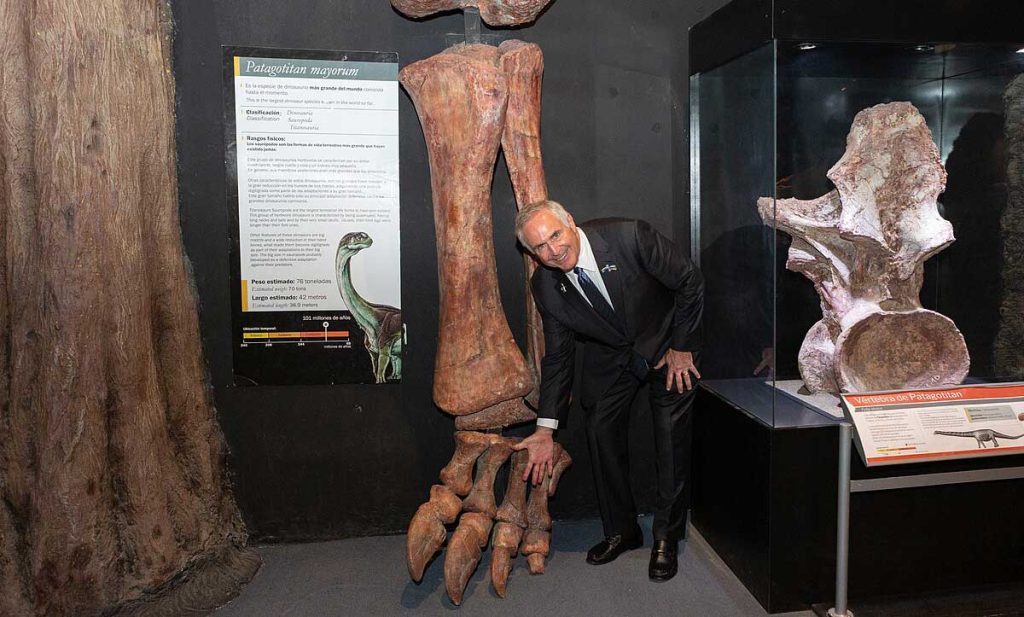 Patagotitan bones by Embajada de EEUU en Argentina is licensed under CC BY 2.0.
Dreadnoughtus63: Go to reference 63 at the end of the page is one of the largest titanosaurs known from a nearly complete skeleton, making it an especially important discovery for understanding these giants. It lived in what is now Patagonia about 77 million years ago and may have reached around 26 metres in length with an estimated weight of 50 to 60 tonnes. Its name means “fears nothing,” a nod both to its enormous size and to the British battleships called dreadnoughts that inspired the term. The name captures the sheer presence of an animal so massive that, as an adult, it would have been virtually immune to predators.
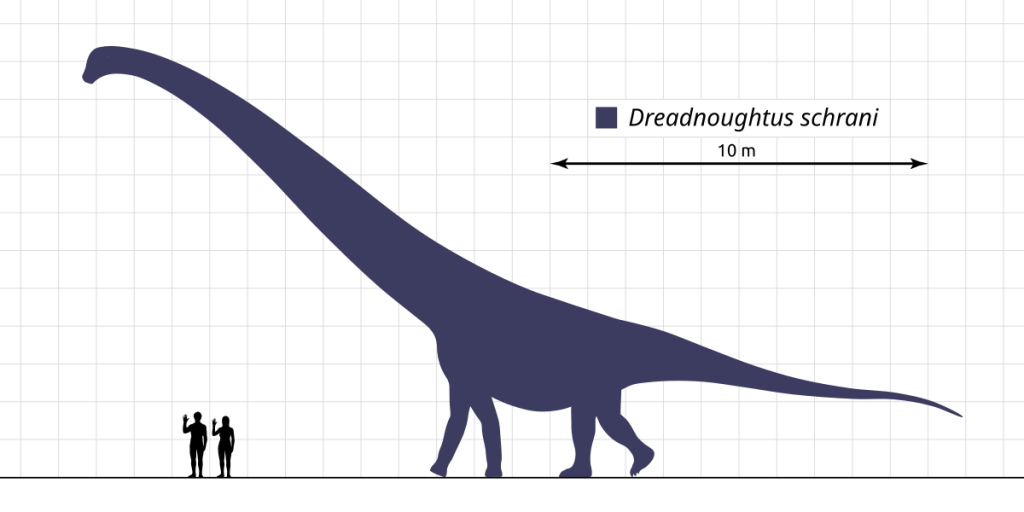 Dreadnoughtus Scale by Steveoc 86 and Kevin Yan is licensed under CC BY-SA 4.0.
The discovery of Dreadnoughtus schrani provided an exceptionally complete view of a giant titanosaur’s anatomy. Fossils from the Cerro Fortaleza Formation in Santa Cruz Province, Argentina, yielded over 70% of the skeleton, excluding the skull. Notably, the limb bones are robust, with thick, weight-bearing shafts capable of supporting an enormous body mass without sacrificing mobility. The vertebrae exhibit a complex network of air spaces, lightening the skeleton while maintaining strength, a feature that likely facilitated efficient movement of its colossal frame. Muscle attachment points on the shoulder and hip bones indicate the immense power required for walking, turning, and lifting its long neck. These anatomical features suggest that Dreadnoughtus was capable of steady, energy-efficient travel across vast floodplains in search of food. The exceptional preservation of the bones has allowed scientists to estimate proportions more accurately than is possible for most giant sauropods, making Dreadnoughtus a key reference point for reconstructing the appearance and biomechanics of other incomplete titanosaur remains.64: Go to reference 64 at the end of the page
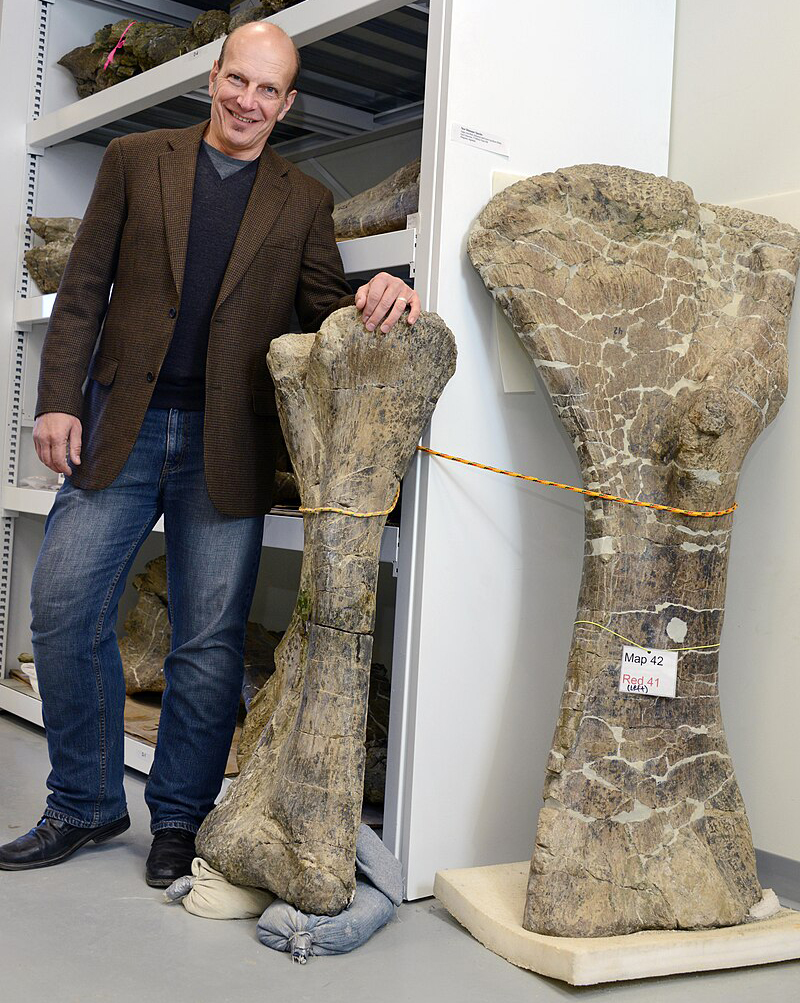 Lacovara and Dreadnoughtus by ABelov2014 is licensed under CC BY-SA 4.0.
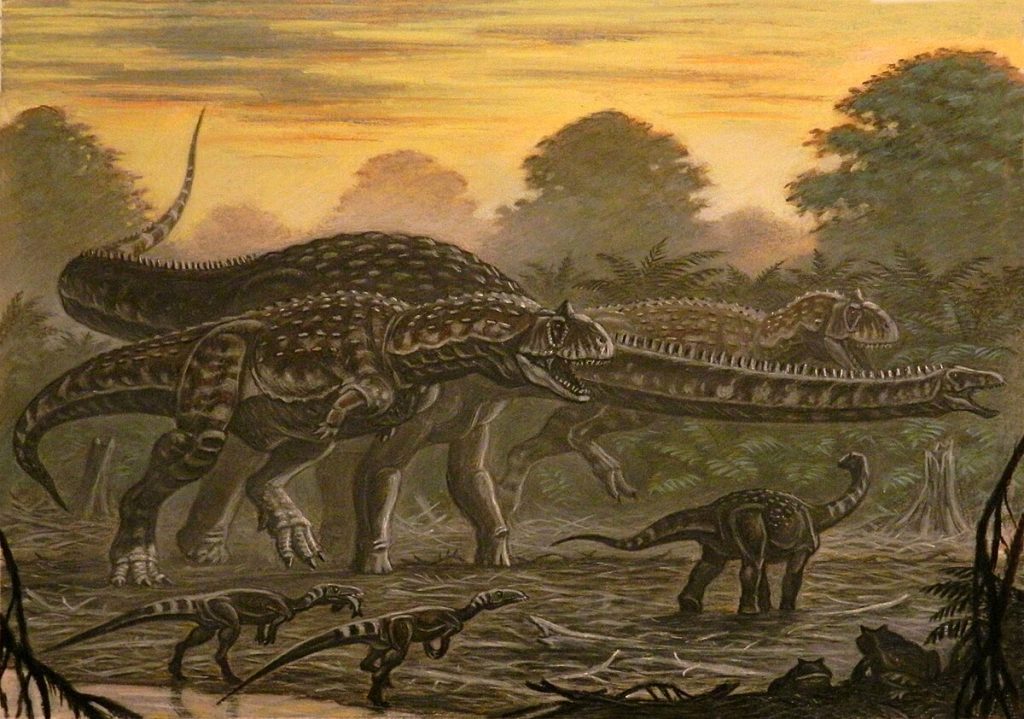 Majungasaurus Masiakasaurus, Rapetosaurus by ABelow2014 is licensed under CC BY-SA 3.0.
Rapetosaurus65: Go to reference 65 at the end of the page lived in Madagascar around 70 million years ago and is especially important because both adult and juvenile fossils have been found. Measuring about 15 metres long as an adult, it was smaller than the South American giants but still impressive in size. The discovery of a nearly complete juvenile skeleton has provided rare insights into how titanosaurs grew and lived. Bone analysis suggests that young Rapetosaurus were relatively independent soon after hatching, indicating that these dinosaurs may not have provided extended parental care. This early self-sufficiency would have been a valuable survival strategy in predator-rich Cretaceous ecosystems.
Saltasaurus66: Go to reference 66 at the end of the page was a remarkable titanosaur not for its size, but for its armour. Living in Argentina around 70 million years ago, it was relatively small for a member of its group, measuring about 12 to 15 metres in length. What made it stand out was the presence of bony plates, called osteoderms, embedded in its skin. These armour plates provided some protection against predators, making Saltasaurus the first sauropod found with such defensive adaptations. Its discovery in the 1980s was a turning point in understanding sauropod diversity, proving that not all were towering giants and that some evolved more compact, heavily defended body plans. This combination of smaller size and armour gave Saltasaurus a unique niche in the Late Cretaceous ecosystems of South America, showing that even among the last of the sauropods, there was still room for innovation.
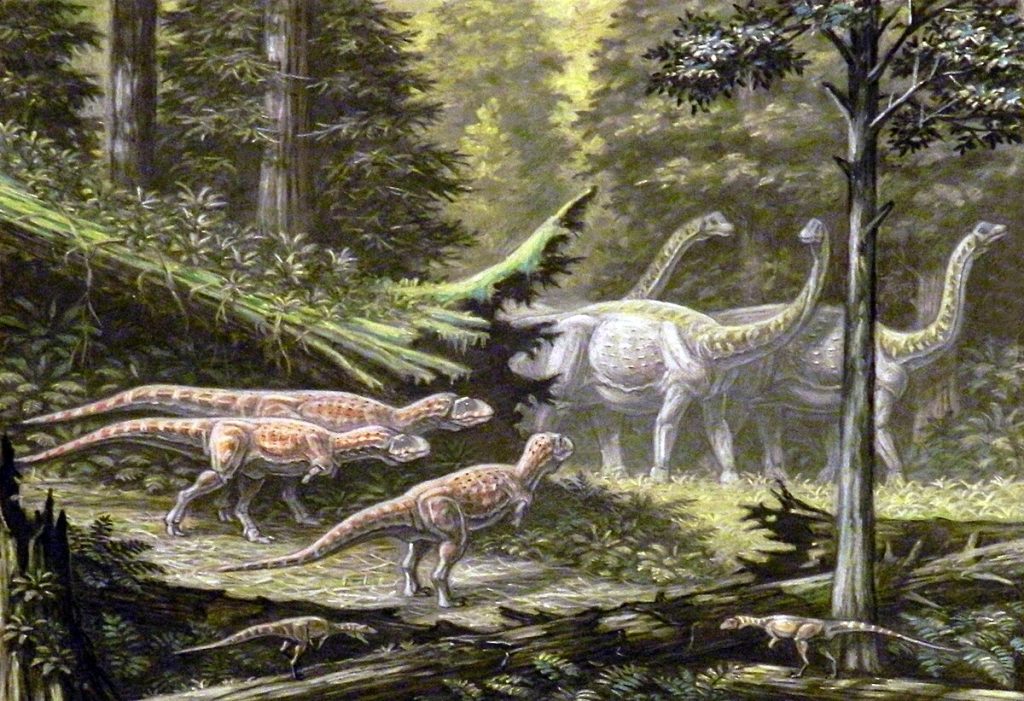 Saltasaurus environment by ABelow2014 is licensed under CC BY 3.0.
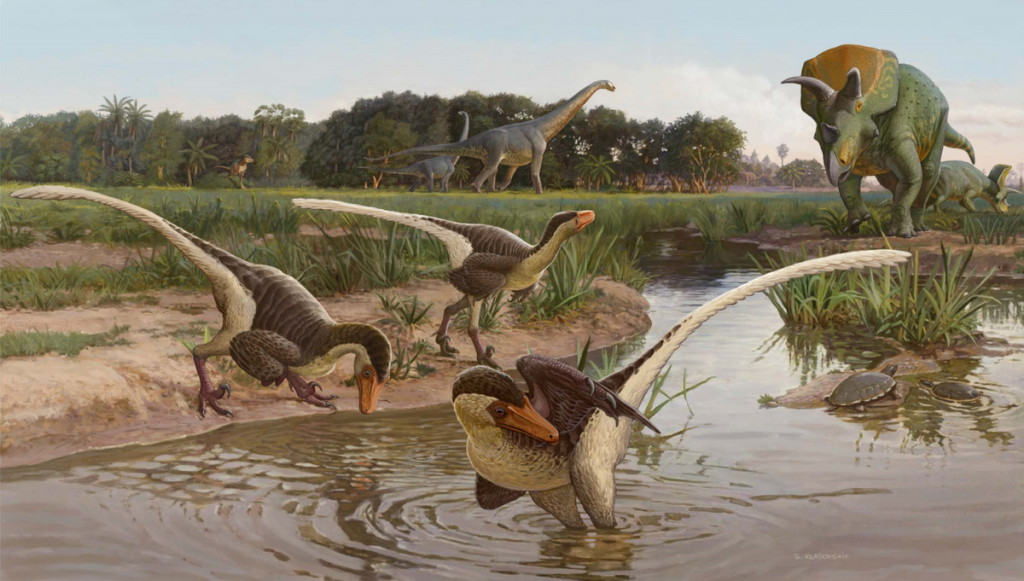 Dineobellator by Sergey Krasovskiy is licensed under CC BY 4.0.
Alamosaurus67: Go to reference 67 at the end of the page was one of the last surviving sauropods in North America, living during the very end of the Cretaceous period about 70 to 66 million years ago. It could reach lengths of around 21 metres and weigh up to 30 tonnes, making it a giant in its ecosystem.
Fossils have been found across the southern United States, particularly in Texas and New Mexico, suggesting it was well adapted to the warm, semi-arid environments of the Late Cretaceous. Its presence so close to the mass extinction event shows that titanosaurs were still thriving in some regions right up until the end of the dinosaur era.
In conclusion
From their humble beginnings as small, two-legged plant eaters to the towering titans that closed out the Age of Dinosaurs, sauropods were masters of adaptation. They filled every herbivorous niche from low grazing diplodocids to high browsing brachiosaurids, sturdy macronarians, and the mighty titanosaurs that roamed nearly every continent. More than just big dinosaurs, they were a 100 million year experiment in size, survival, and diversity, one that still captures our imagination today.
Want to keep reading?
Finished this post but you still feel like reading? Check out one of my other posts about prehistoric animals:
- Come Fly with Me (May 12, 2025)
- Crocodile Rock (July 13, 2025)
Notes & references
 R: The Land Before Time (film). (2025, August 10). In Wikipedia. https://en.wikipedia.org/wiki/The_Land_Before_Time_(film)
- R: VHS. (2025, August 9). In Wikipedia. https://en.wikipedia.org/wiki/VHS
- R: Emily Osterloff. Brontosaurus: Reinstating a prehistoric icon. Natural History Museum. https://www.nhm.ac.uk/discover/brontosaurus-reinstating-a-prehistoric-icon.html
- R: Sauropoda. (2025, August 5). In Wikipedia. https://en.wikipedia.org/wiki/Sauropoda
- R: Mesozoic. (2025, July 1). In Wikipedia. https://en.wikipedia.org/wiki/Mesozoic
- R: Curtin University. (2025, June 10). Dinosaur’s last meal identified for first time. ScienceDaily. https://www.sciencedaily.com/releases/2025/06/250610080025.htm
- R: Brontosaurus. (2025, August 9). In Wikipedia. https://en.wikipedia.org/wiki/Brontosaurus
- R: Diplodocus. (2025, July 29). In Wikipedia. https://en.wikipedia.org/wiki/Diplodocus
- R: Theropoda. (2025, August 7). In Wikipedia. https://en.wikipedia.org/wiki/Theropoda
- R: Saurischia. (2025, July 12). In Wikipedia. https://en.wikipedia.org/wiki/Saurischia
- R: Ornithischia. (2025, August 2). In Wikipedia. https://en.wikipedia.org/wiki/Ornithischia
- R: Geggel, L. (2023, December 31). Why was the name ‘Brontosaurus’ brought back from the dead? Live Science. https://www.livescience.com/animals/dinosaurs/why-was-the-name-brontosaurus-brought-back-from-the-dead
- R: Sauropodomorpha. (2025, August 8). In Wikipedia. https://en.wikipedia.org/wiki/Sauropodomorpha
- R: Bates, K. T., Mannion, P. D., Falkingham, P. L., Brusatte, S. L., Hutchinson, J. R., Otero, A., Sellers, W. I., Sullivan, C., Stevens, K. A., & Allen, V. (2016). Temporal and phylogenetic evolution of the sauropod dinosaur body plan. Royal Society Open Science, 3(3), 150636. https://doi.org/10.1098/rsos.150636
- R: Otero, A., Cuff, A. R., Allen, V., Sumner‑Rooney, L., Pol, D., & Hutchinson, J. R. (2019). Ontogenetic changes in the body plan of the sauropodomorph dinosaur Mussaurus patagonicus reveal shifts of locomotor stance during growth. Scientific Reports, 9, Article 7614. https://doi.org/10.1038/s41598-019-44037-1
R: Lefebvre, R., Aubry, C., Mallison, H., & Houssaye, A. (2025). Evolution of the sauropodomorph astragalus: Relationships with the emergence of the sauropod bauplan and weight-bearing function, and critical appraisal of evolutionary rate estimation. Zoological Journal of the Linnean Society, 204(4), Article zlaf077. https://doi.org/10.1093/zoolinnean/zlaf077 - R: Pangaea. (2025, July 1). In Wikipedia. https://en.wikipedia.org/wiki/Pangaea
- R: Chromogisaurus. (2025, May 19). In Wikipedia. https://en.wikipedia.org/wiki/Chromogisaurus
- R: Panphagia. (2025, May 9). In Wikipedia. https://en.wikipedia.org/wiki/Panphagia
- R: Ischigualasto Formation. (2025, July 7). In Wikipedia. https://en.wikipedia.org/wiki/Ischigualasto_Formation
- R: Saturnalia tupiniquim. (2025, May 7). In Wikipedia. https://en.wikipedia.org/wiki/Saturnalia_tupiniquim
- R: Santa Maria Formation. (2025, August 3). In Wikipedia. https://en.wikipedia.org/wiki/Santa_Maria_Formation
- R: Isanosaurus. (2025, June 1). In Wikipedia. https://en.wikipedia.org/wiki/Isanosaurus
- R: I Know Dino. (2023, January 18). Episode 425: Microraptor ate mammals [Episode 425: Microraptor ate mammals]. I Know Dino: The Big Dinosaur Podcast. Retrieved August 13, 2025, from https://iknowdino.com/isanosaurus-episode-425/
- R: Antetonitrus. (2025, May 20). In Wikipedia. https://en.wikipedia.org/wiki/Antetonitrus
- R: McPhee, B. (2024, December 22). Antetonitrus | Early sauropod relative “Before the Thunder”. TheDinosaurs.org. https://thedinosaurs.org/dinosaurs/antetonitrus
- R: Gutierrez, B. (2012, October 30) (n.d.). Antetonitrus. Prehistoric Wildlife. https://www.prehistoric-wildlife.com/species/antetonitrus/
- R: Carrano, M. T. (2005). The transition to quadrupedalism in Sauropoda [Figure]. In The evolution of sauropod locomotion: Morphological diversity of a secondarily quadrupedal radiation (Chapter). https://www.researchgate.net/figure/The-transition-to-quadrupedalism-in-Sauropoda-Although-basal-sauropods-were-likely_fig1_230808728
- R: Yates, A. M., & Kitching, J. W. (2003). The earliest known sauropod dinosaur and the first steps towards sauropod locomotion. Proceedings of the Royal Society B: Biological Sciences, 270(1525), 1753–1758. https://doi.org/10.1098/rspb.2003.2417
- R: Lessemsaurus. (2025, August 7). In Wikipedia. https://en.wikipedia.org/wiki/Lessemsaurus
- R: Dinosaur Fact. (n.d.). Lessemsaurus dinosaur. Dinosaur Fact. https://www.dinosaurfact.net/Triassic/Lessemsaurus.php
- R: Apaldetti, G. C., Ezcurra, M. D., Martinez, R. N., Cerda, I. A., Peyre de Fabreguès, C., & Abelín, D. (2025). PEAPA – A new lessemsaurid specimen from the Late Triassic of Argentina increases the upper boundary of gigantism in the early evolution of Sauropodomorpha [Conference paper]. Asociación Paleontológica Argentina. https://bicyt.conicet.gov.ar/fichas/produccion/12304535
- R: Leonerasaurus. (2025, May 14). In Wikipedia. https://en.wikipedia.org/wiki/Leonerasaurus
- R: Pol, D., Garrido, A., & Cerda, I. A. (2011). A new sauropodomorph dinosaur from the Early Jurassic of Patagonia and the origin and evolution of the sauropod-type sacrum. PLoS ONE, 6(1), e14572. https://doi.org/10.1371/journal.pone.0014572
- R: Vulcanodon. (2025, August 8). In Wikipedia. https://en.wikipedia.org/wiki/Vulcanodon
- R: Gutierrez, B. (2016, January 23) Vulcanodon. Prehistoric Wildlife. https://www.prehistoric-wildlife.com/species/antetonitrus/
- R: Choiniere, J. N., et al. (2024). New dinosaur discovered in Zimbabwe reveals early evolution of sauropods. Discover Magazine. https://www.discovermagazine.com/new-dino-discovered-in-zimbabwe-reveals-early-evolution-of-sauropods-46338
- R: Encyclopedia Britannica. (n.d.). Sauropod. Britannica. https://www.britannica.com/animal/sauropod
- R: Barrett, P. M., & Upchurch, P. (2010). Evolution of sauropod feeding mechanisms. In D. E. Fastovsky & D. B. Weishampel (Eds.), The Evolution of Herbivory in Terrestrial Vertebrates (pp. 205–230). Cambridge University Press. https://www.cambridge.org/core/books/evolution-of-herbivory-in-terrestrial-vertebrates/evolution-of-sauropod-feeding-mechanisms/333C5E189771FAC6E212A719B0024A6F
- R: Diplodocidae. (2025, May 25). In Wikipedia. https://en.wikipedia.org/wiki/Diplodocidae
- R: Diplodocus. (2025, August 20). In Wikipedia. https://en.wikipedia.org/wiki/Diplodocus
- R: Apatosaurus. (2025, August 19). In Wikipedia. https://en.wikipedia.org/wiki/Apatosaurus
- R: Brontosaurus. (2025, August 9). In Wikipedia. https://en.wikipedia.org/wiki/Brontosaurus
- R: Upchurch, P., Barrett, P. M., & Dodson, P. (2004). Sauropoda. In D. B. Weishampel, P. Dodson, & H. Osmólska (Eds.), The Dinosauria (2nd ed., pp. 259–322). University of California Press.
- R: McIntosh, J. S., & Berman, D. S. (1997). Seismosaurus hallorum: A giant diplodocid from the Late Jurassic of New Mexico [PDF]. University of New Mexico. https://econtent.unm.edu/digital/api/collection/bulletins/id/791/download
- R: Morrison Formation. (2025, July 5). In Wikipedia. https://en.wikipedia.org/wiki/Morrison_Formation
- R: Brachiosauridae. (2025, August 12). In Wikipedia. https://en.wikipedia.org/wiki/Brachiosauridae
- R: Brachiosaurus. (2025, July 29). In Wikipedia. https://en.wikipedia.org/wiki/Brachiosaurus
- R: Giraffatitan. (2025, June 23). In Wikipedia. https://en.wikipedia.org/wiki/Giraffatitan
- R: Greshko, M. (2012, October 3). Brachiosaurus: Facts about the giraffe-like dinosaur. Live Science. https://www.livescience.com/25024-brachiosaurus.html
- R: Taylor, M. P., Wedel, M. J., & Naish, D. (2009). Restoring maximum vertical browsing reach in sauropod dinosaurs. Anatomical Record, 292(10), 1397–1406. https://doi.org/10.1002/ar.23617
- R: Dinosaurs in Jurassic Park. (2025, August 4). In Wikipedia. https://en.wikipedia.org/wiki/Dinosaurs_in_Jurassic_Park
- R: Macronaria. (2025, August 19). In Wikipedia. https://en.wikipedia.org/wiki/Macronaria
- R: Camarasaurus. (2025, August 17). In Wikipedia. https://en.wikipedia.org/wiki/Camarasaurus
- R: Kent, D. (n.d.). Camarasaurus. University of Oregon. https://ix.cs.uoregon.edu/~kent/paleontology/sauropods/Camarasaurus/index.html
- R: Prehistoric 101. (n.d.). Camarasaurus. Prehistoric Learn. https://prehistoriclearn.com/dinosaurs/camarasaurus/
- R: Titanosauria. (2025, August 9). In Wikipedia. https://en.wikipedia.org/wiki/Titanosauria
- R: Argentinosaurus. (2025, August 20). In Wikipedia. https://en.wikipedia.org/wiki/Argentinosaurus
- R: Homer, T. (2025, January 8). Argentinosaurus was almost half as long as a football field. HowStuffWorks. https://animals.howstuffworks.com/dinosaurs/argentinosaurus.htm
- R: Argentinosaurus. Prehistory Wiki. https://project-prehistory.fandom.com/wiki/Argentinosaurus
- R: Patagotitan. (2025, August 50). In Wikipedia. https://en.wikipedia.org/wiki/Patagotitan
- R: What was the biggest dinosaur? Natural History Museum. https://www.nhm.ac.uk/discover/what-is-the-biggest-dinosaur.html
- R: Putting the “Titan” in titanosaur. Field Museum. https://www.fieldmuseum.org/blog/putting-titan-titanosaur
- R: Dreadnoughtus. (2025, July 30). In Wikipedia. https://en.wikipedia.org/wiki/Dreadnoughtus
- R: Lacovara, K. (2014, September 4). Digging deeper into Dreadnoughtus: Dinosaur interview with Ken Lacovara. Drexel University News Blog. https://newsblog.drexel.edu/2014/09/04/digging-deeper-into-dreadnoughtus-dinosaur-interview-with-ken-lacovara/
R: Drexel University. (2014, September). Drexel team unveils Dreadnoughtus: A gigantic, exceptionally complete sauropod dinosaur. Drexel University News. https://drexel.edu/news/archive/2014/september/dreadnoughtus-dinosaur - R: Rapetosaurus. (2025, July 20). In Wikipedia. https://en.wikipedia.org/wiki/Rapetosaurus
- R: Saltasaurus. (2025, July 5). In Wikipedia. https://en.wikipedia.org/wiki/Saltasaurus
- R: Alamosaurus. (2025, August 22). In Wikipedia. https://en.wikipedia.org/wiki/Alamosaurus