After a short detour into prehistoric reptiles, it’s time to return to our tour of the Solar System. When we left off, we had just crossed the asteroid belt, which means we’ve finally reached the outer Solar System. This stage of the journey is especially exciting, because it brings us to Earth’s two giant siblings: Jupiter and Saturn. The voluptuous rump of the Solar System, if you will.
Every planet has something unique to offer, but none capture my imagination quite like these two. From Jupiter’s swirling Great Red Spot1: Go to reference 1 at the end of the page to Saturn’s iconic rings2: Go to reference 2 at the end of the page, they stand as symbols of beauty and mystery. More than any others, Jupiter and Saturn fuel a sense of wonder and invite us to picture what human life might look like if we ever colonised the wider Solar System.
Jupiter and its moons Io and Europa rendered in Celestia 1.7.0. Europa is closest, Jupiter is furthest. Jupiter, Io, and Europa by TheLostProbe (Screenshot), Askaniy Anpilogov + FarGetaNik / JaguarJack/Panterstruck (Textures) is licensed under CC BY-SA 4.0.
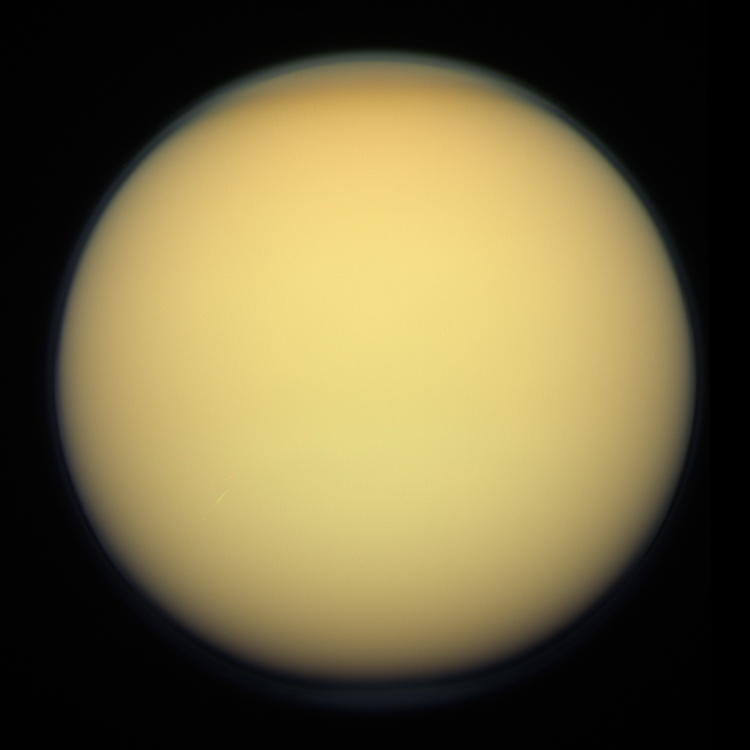
A mosaic of nine processed images acquired during Cassini’s first very close flyby of Saturn’s moon Titan on Oct. 26, 2004. Titan by NASA is in the public domain.
Not the planets themselves, of course. Colonising a rocky neighbour like Mars feels at least faintly possible, but Jupiter and Saturn are gas giants,3: Go to reference 3 at the end of the page immense spheres of hydrogen and helium with no solid ground to land on. Any spacecraft attempting to descend would be crushed by the overwhelming pressure long before approaching the core. The real promise lies not in the giants themselves but in their moons, which form a diverse set of targets, some of the most compelling in the entire Solar System.
Jupiter’s Europa,4: Go to reference 4 at the end of the page with its hidden ocean beneath an icy crust, excites astrobiologists with the possibility of life. Its sister Ganymede,5: Go to reference 5 at the end of the page the largest moon in the Solar System, is bigger than Mercury and almost a planet in its own right. Saturn’s Titan,6: Go to reference 6 at the end of the page wrapped in a thick atmosphere and dotted with methane lakes, is strangely reminiscent of Earth in many ways. These moons may be hostile by human standards, but they hold the raw materials and scientific mysteries that make them some of the most compelling places we could ever hope to explore.
Jupiter: The Sky Father
Jupiter7: Go to reference 7 at the end of the page is the undisputed heavyweight of the Solar System, a planet so massive that it contains more than twice the material of all the other planets combined. Its immense gravity has shaped the history of the Solar System, shepherding asteroids, deflecting comets, and in many cases protecting the inner planets from catastrophic impacts.
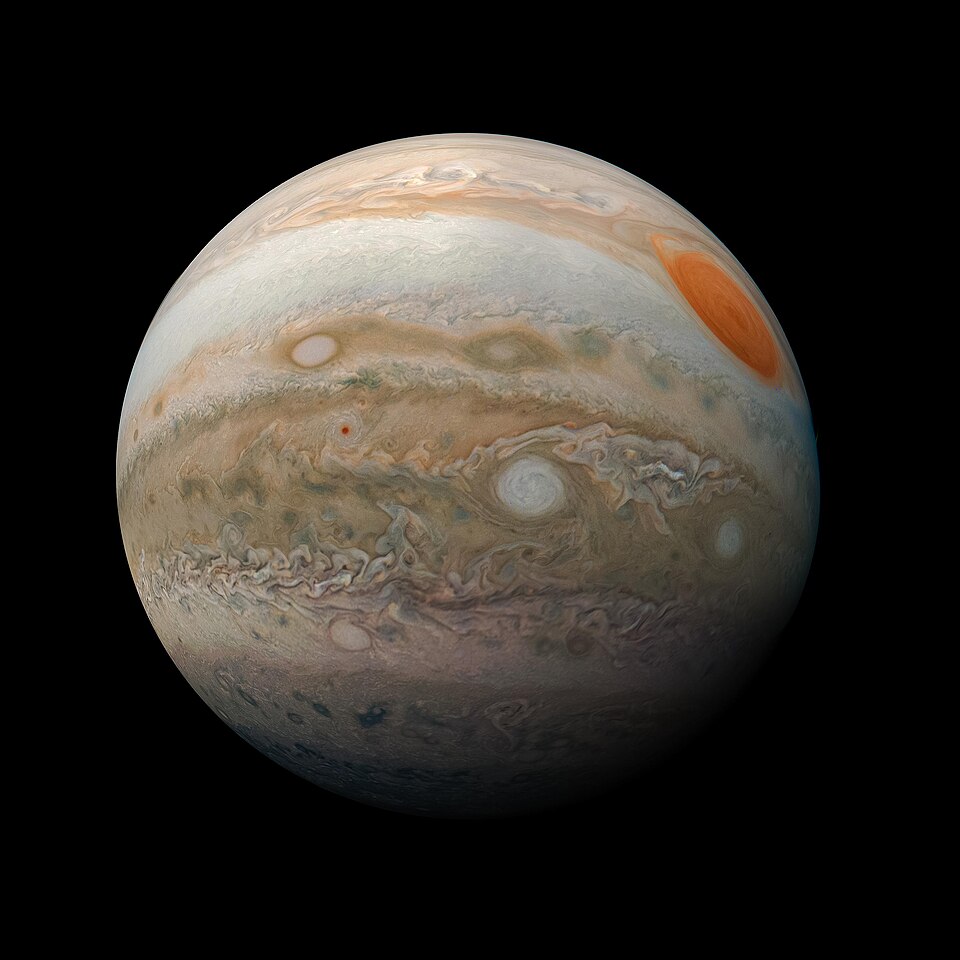
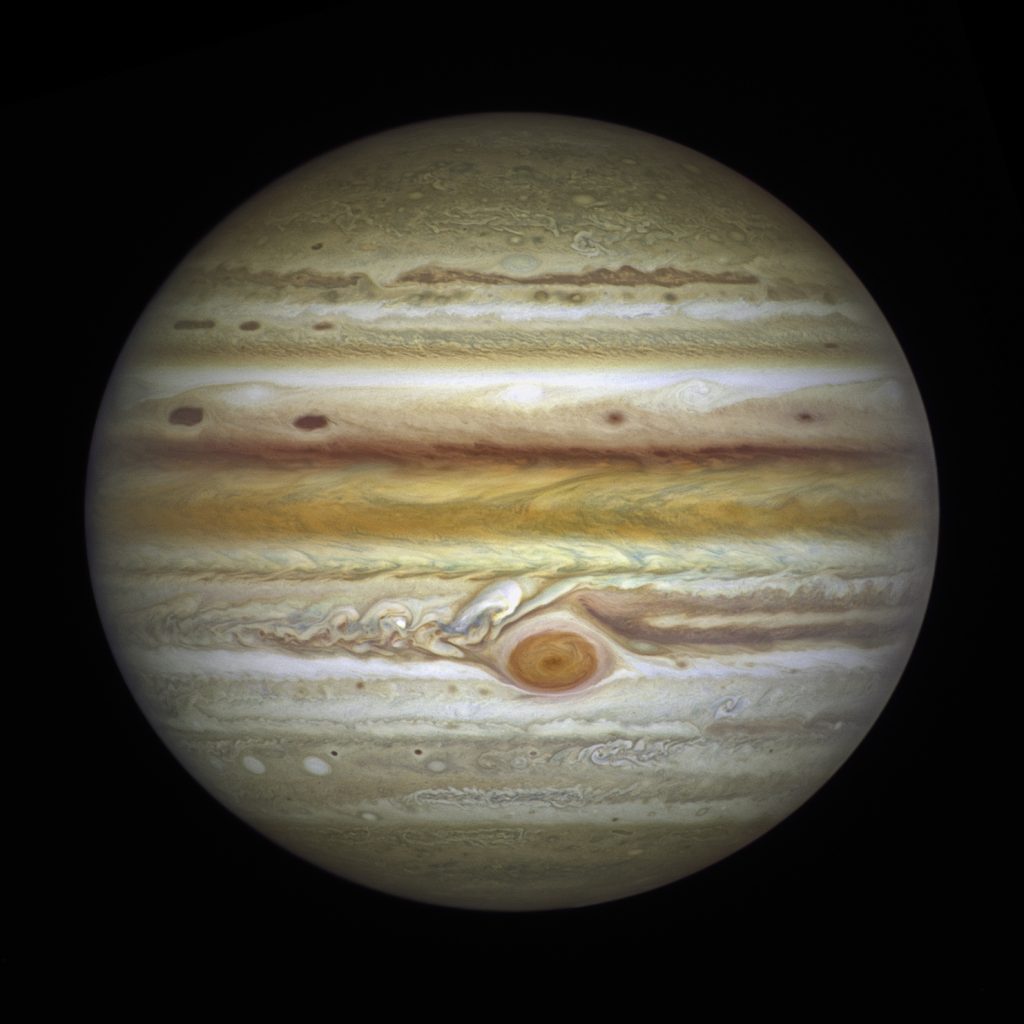
Visually, Jupiter is a world of swirling storms and colourful cloud bands, dominated by the famous Great Red Spot, a raging anticyclone larger than Earth that has persisted for centuries. It has been observed for at least 350 years,8: Go to reference 8 at the end of the page making it the longest continuously monitored storm in the Solar System. The first confirmed sighting is often credited to the Italian astronomer Giovanni Cassini9: Go to reference 9 at the end of the page in 1665, who described a “permanent spot” on Jupiter’s surface. Since then, generations of astronomers have tracked its changing size and colour through telescopes, sketching and later photographing its turbulent form.
This striking view of Jupiters Great Red Spot and turbulent southern hemisphere was captured by NASAs Juno spacecraft as it performed a close pass of the gas giant planet. Jupiter Red Spot by NASA is in the public domain.
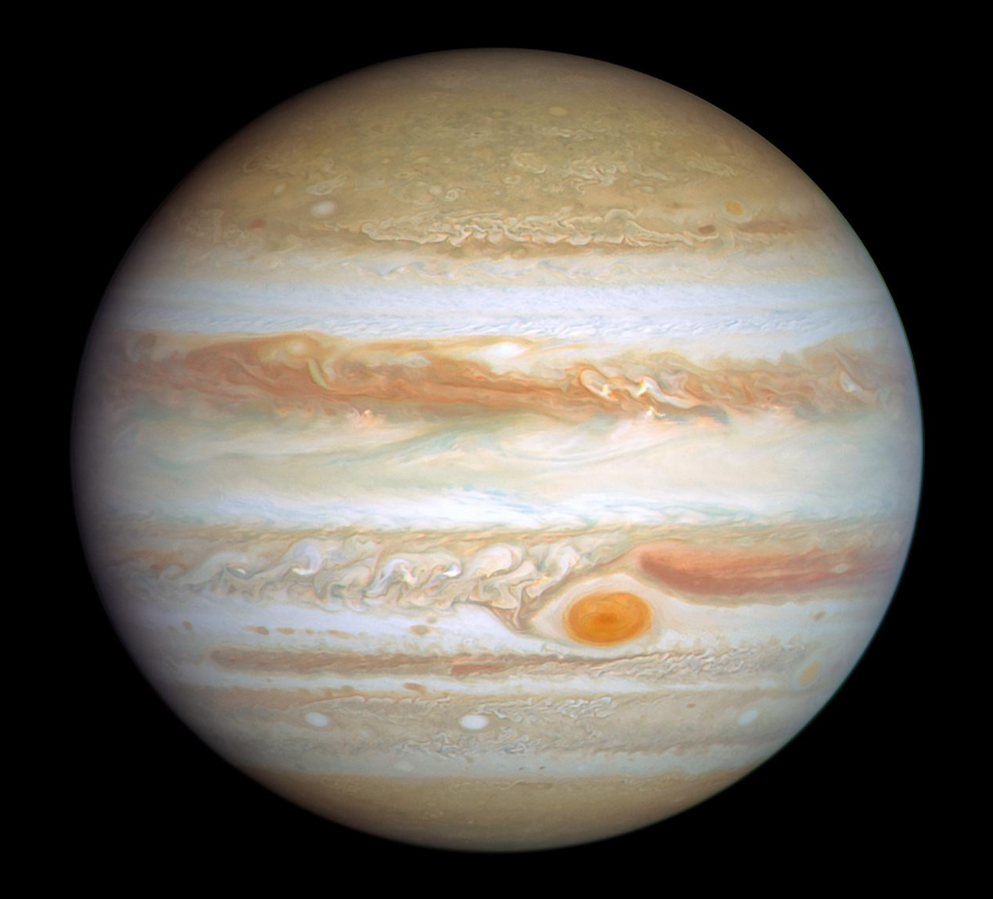
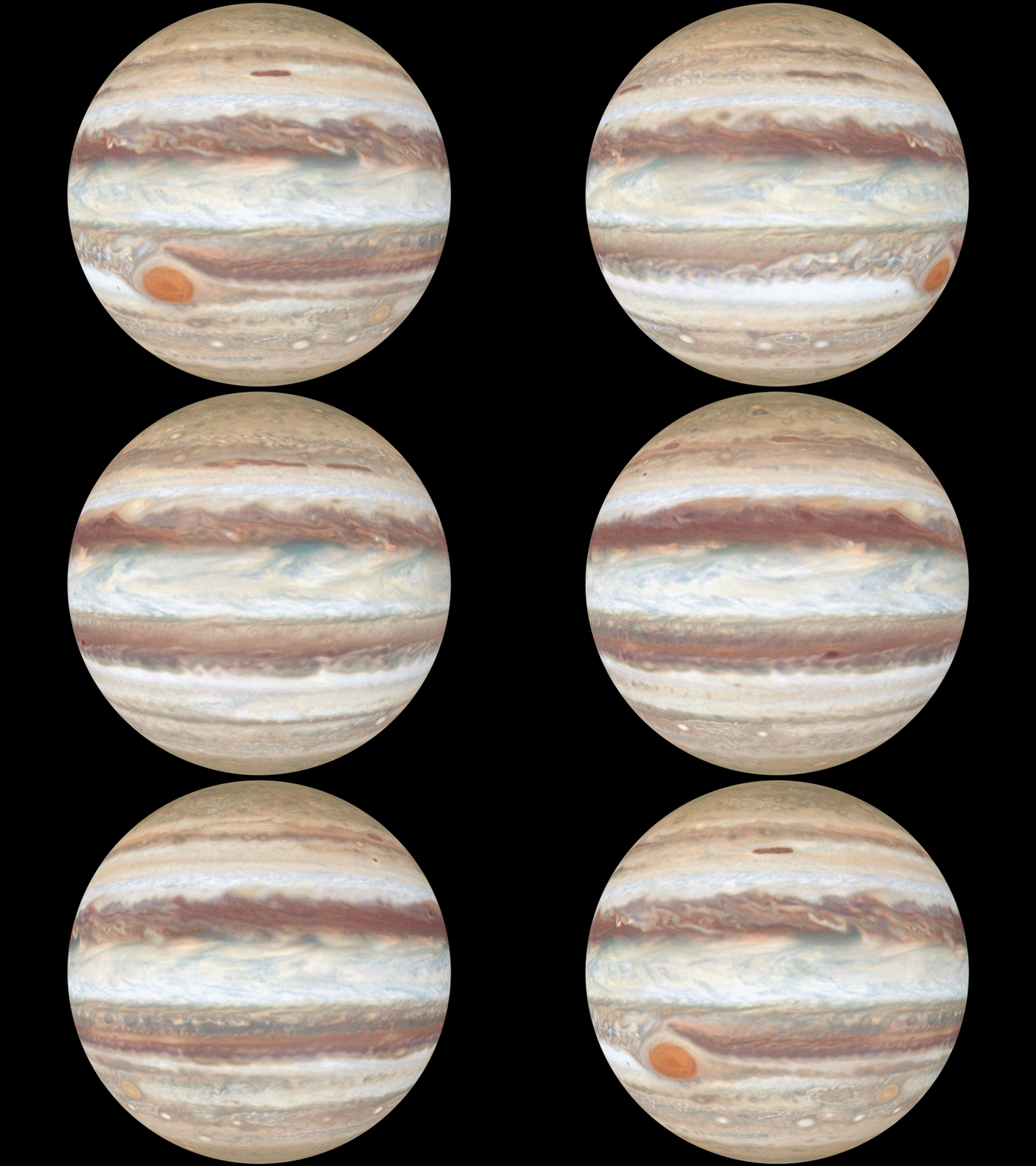
Image of Jupiter taken in 2021 by the Hubble Space Telescope. Jupiter Hubble 2021 by NASA is in the public domain.
Despite centuries of observation, the storm remains something of a mystery. We know it is an anticyclonic vortex, with winds circling counterclockwise at speeds of up to 430 km/h. At its peak in the late 19th century, it stretched more than 40,000 km across, large enough to swallow three Earths side by side. In recent decades, however, the spot has been shrinking, now measuring just under 16,000 km across, and its hue has shifted from deep brick red to a paler orange.10: Go to reference 10 at the end of the page
What drives the storm’s longevity is still not fully understood. Some models suggest that Jupiter’s deep atmosphere supplies energy that sustains it, while others propose that neighbouring jet streams help confine and reinforce the vortex. Spacecraft like Voyager, Galileo, and Juno have all contributed crucial data, yet the Great Red Spot continues to challenge our understanding of planetary weather.11: Go to reference 11 at the end of the page
YETI SIDEBAR
Jupiter may have played a central role in shaping the entire Solar System. Early in its history, it likely did not remain in a fixed orbit, but instead migrated inward toward the Sun before reversing course and moving back outward, in a process known as the “Grand tack hypothesis.”12: Go to reference 12 at the end of the page This dramatic movement scattered and reshaped the orbits of smaller bodies, influencing where the rocky planets formed and helping to clear the asteroid belt. Without Jupiter’s gravitational guidance, the inner planets might look very different today.
Its immense mass made Jupiter a cosmic architect. By shepherding comets and asteroids, it helped shield the inner planets from frequent catastrophic impacts during the Solar System’s formative years. In this way, Jupiter’s presence not only dominated the outer Solar System but also helped create the stable conditions that eventually allowed life to emerge on Earth.
Exploring the Giant
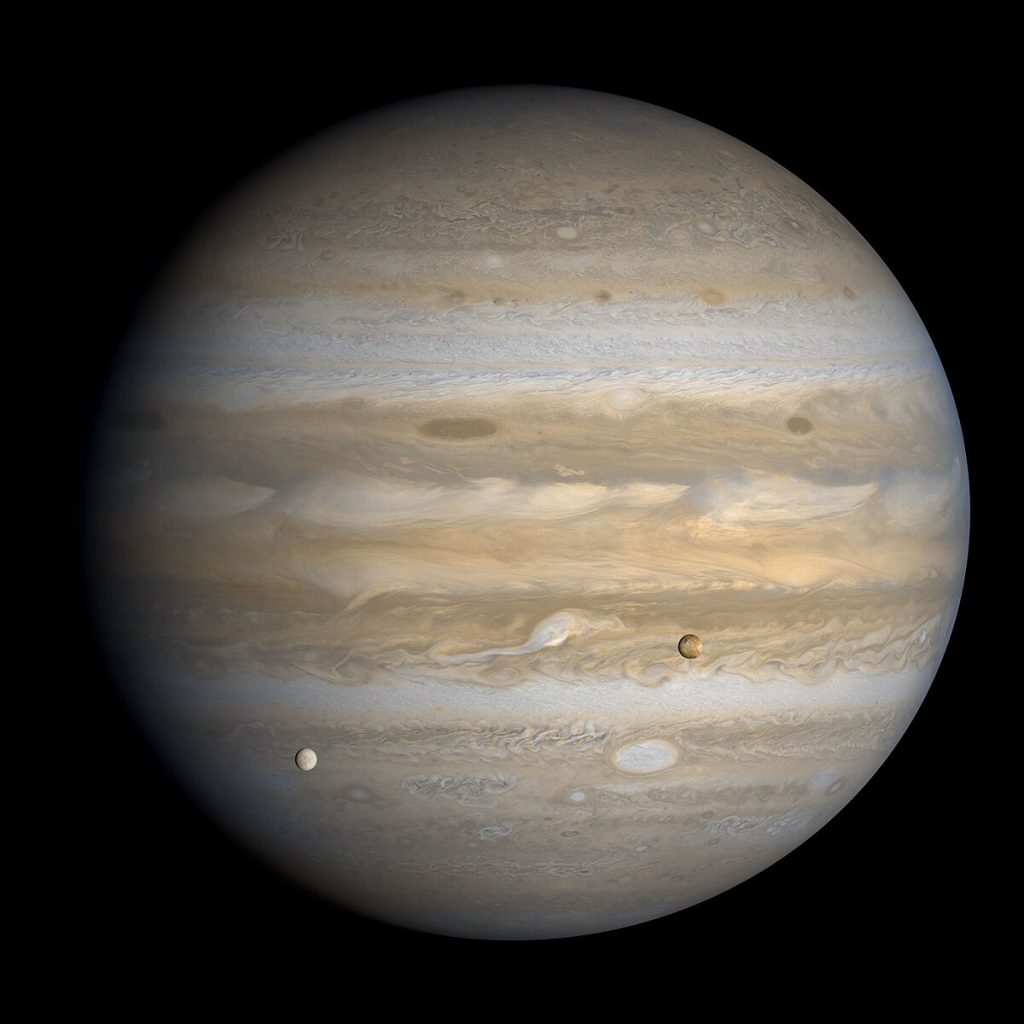
Modern exploration of Jupiter began in the 1970s with NASA’s Pioneer 1013: Go to reference 13 at the end of the page and 11,14: Go to reference 14 at the end of the page the first spacecrafts to pass through the outer solar system. Pioneer 10 made the first direct observations of Jupiter in 1973, followed a year later by Pioneer 11, and both missions revealed the vast scale of the planet’s magnetic field and radiation environment. They were succeeded in 1979 by Voyager 115: Go to reference 15 at the end of the page and 2,16: Go to reference 16 at the end of the page whose flybys transformed our view of the Jovian system. The Voyagers delivered stunning close-up images of Jupiter’s atmosphere and moons, discovered active volcanism on Io, and revealed that Jupiter possesses faint rings. These early missions set the stage for more detailed exploration.
In 1995, Galileo17: Go to reference 17 at the end of the page became the first spacecraft to orbit Jupiter, delivering nearly a decade of close study. It released a probe into Jupiter’s atmosphere and repeatedly flew by the Galilean moons, uncovering strong evidence that Europa, Ganymede, and Callisto hide subsurface oceans beneath their icy crusts. Galileo also showed that Ganymede has its own magnetic field, a unique feature among moons.
A double transit of Jupiter by moons Io and Europa, as observed by Voyager 1 on its approach on February 27, 1979. Voyager 1 Image of Jupiter with Io and Europa by NASA / JPL / Bjorn Jonsson is in the public domain.
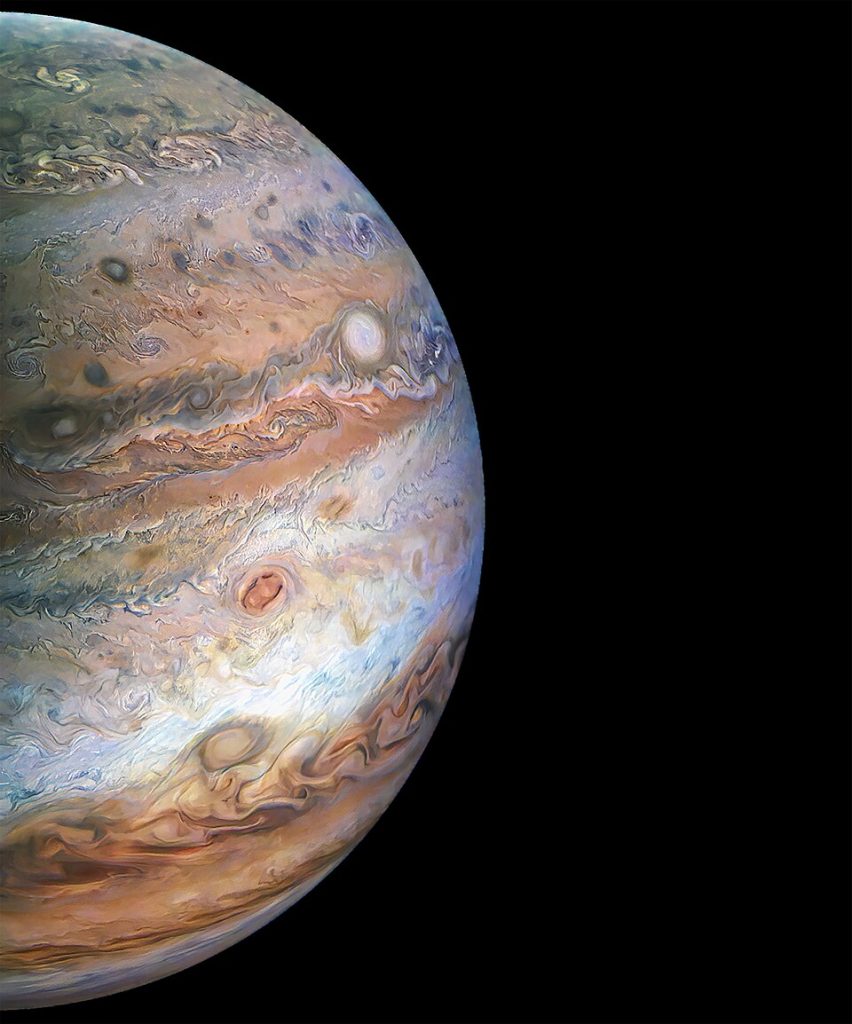
Processed image from the Juno Spacecraft orbiting Jupiter. Jupiter – NASA JUNO by NASA and Nova Dawn Astrophotography is licensed under CC BY-SA 4.0.
Today, the Juno mission20: Go to reference 20 at the end of the page continues to orbit Jupiter, having arrived in 2016. Its instruments probe beneath the cloud tops to reveal how the planet’s atmosphere circulates and how its interior is structured. Juno has also made close passes of moons such as Ganymede, Europa, and Io, offering new insights into their geology and magnetic environments. By combining these findings with decades of earlier data, scientists are building a clearer picture of how Jupiter influences the wider solar system.
The future of Jupiter exploration is equally promising. ESA’s21: Go to reference 21 at the end of the page Jupiter Icy Moons Explorer (JUICE),22: Go to reference 22 at the end of the page launched in 2023, will arrive in 2031 to conduct an in-depth study of Ganymede, Callisto, and Europa, eventually entering orbit around Ganymede. NASA’s Europa Clipper,23: Go to reference 23 at the end of the page launched in 2024 and due to arrive around 2030, will perform dozens of close flybys of Europa to investigate its ocean and potential habitability. China has also proposed the Tianwen-4 mission,24: Go to reference 24 at the end of the page which could orbit Callisto in the mid-2030s. Together with proposed concepts like NASA’s Io Volcano Observer,25: Go to reference 25 at the end of the page these missions highlight how Jupiter remains a central target in the search to understand planetary systems and the possibility of life beyond Earth.
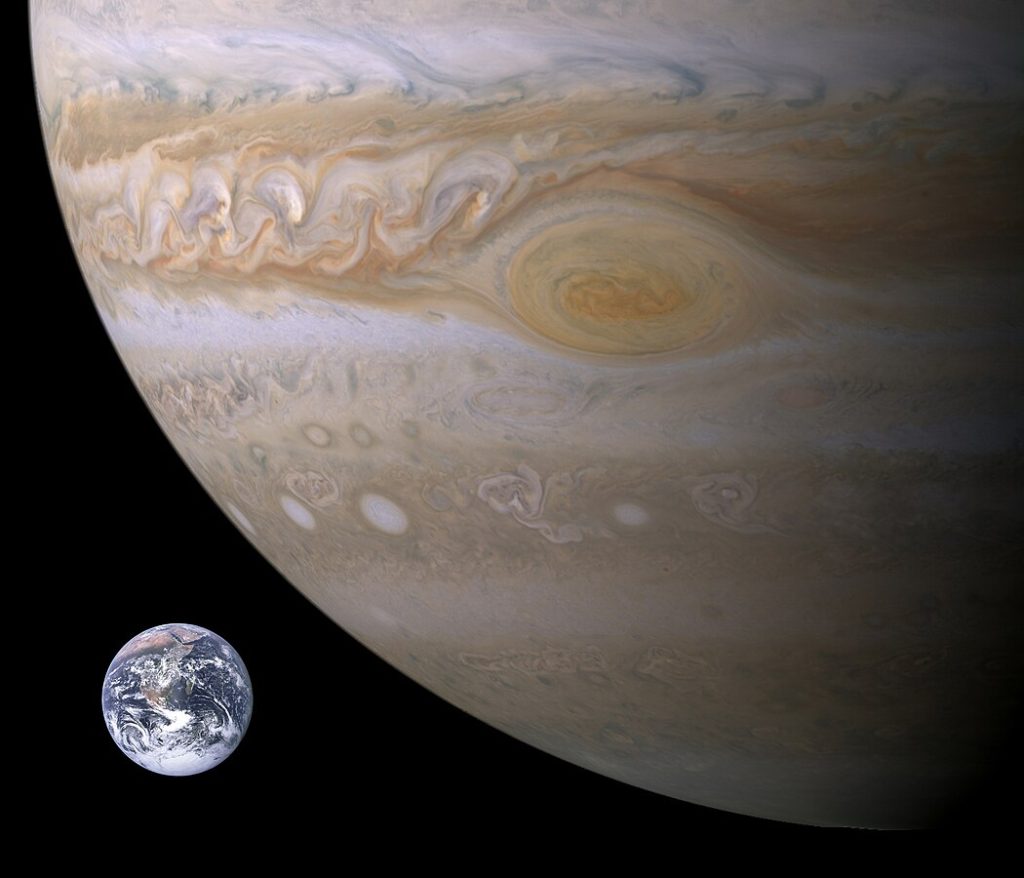
Rough visual comparison of Jupiter and Earth. Approximate scale is 44 km/px. Jupiter Earth size comparison by NASA & Brian0918 is in the public domain.
Jupiter also has a system of faint rings,26: Go to reference 26 at the end of the page though they are nowhere near as prominent as Saturn’s. Composed mainly of tiny dust particles kicked up by impacts on its small inner moons, these rings are subtle and difficult to see from Earth, but they reveal yet another layer of complexity in the planet’s environment. They may be faint, but they are a reminder that even gas giants have structures beyond their swirling atmospheres and mighty magnetic fields.
In terms of sheer scale, Jupiter is a true behemoth. It has a mass roughly 318 times that of Earth and an equatorial diameter of about 143,000 kilometres, making it just over 11 times wider than our planet. Its enormous mass means its gravitational influence extends across the Solar System, helping to shape the orbits of other bodies and even shepherd asteroids, quite fitting for a planet often called the Solar System’s “king of planets”.27: Go to reference 27 at the end of the page
One of the planet’s most striking features is its rapid rotation. Completing a full spin in just under ten hours, the planet experiences extreme centrifugal forces that cause it to bulge at the equator and flatten at the poles.28: Go to reference 28 at the end of the page This fast rotation drives the planet’s complex atmospheric patterns, whipping its clouds into vivid stripes and powering storms that can last for centuries. The combination of speed and size gives Jupiter a level of energy and dynamism unmatched elsewhere in the Solar System, giving it a striking appearance when viewed through telescopes or spacecraft imaging.29: Go to reference 29 at the end of the page
The planet’s atmosphere is a roiling cauldron of gases and clouds, layered in bands of varying colour and composition. Rising and falling gas currents create zones of high and low pressure, forming intricate patterns that shift continuously. Ammonia (NH3), methane (CH4), and water vapour (H2O) interact under extreme temperatures and pressures, producing the reds, browns, and whites of the cloud bands. Lightning storms rage with astonishing intensity, far more powerful than anything on Earth, and massive cyclones appear and disappear over the course of weeks, adding to the planet’s turbulent beauty.30: Go to reference 30 at the end of the page
Jupiter in true color by Hubble’s “Outer Planet Atmospheres Legacy” (OPAL) – January 5 2024 Jupiter OPAL 2024 by NASA is in the public domain.
Jovian weather
Deep within Jupiter, the planet’s atmosphere hides some exotic weather phenomena unlike anything on Earth. In its deep interior, hydrogen and helium are under immense pressure and temperature, the two can become immiscible, allowing helium to condense into droplets that sink through the liquid metallic-hydrogen layer. This “helium rain” doesn’t just change the planet’s chemistry, it also releases additional heat, helping to explain why Jupiter emits more energy than it receives from the Sun.31: Go to reference 31 at the end of the page
Higher up, storms take on an alien form. Observations from NASA’s Juno mission and other instruments suggest that in the upper cloud decks, violent thunderstorms produce slushy ammonia-water ice or hailstones (often dubbed “mushballs”) that form in ammonia-water slush and fall deep into the atmosphere. These storms are accompanied by lightning that is not quite like Earth’s typical water-cloud lightning.32: Go to reference 32 at the end of the page
It almost makes Earth’s weather seem a bit tame by comparison. A deep-winter blizzard may be fierce, but helium-rain precipitation or ammonia-water mushball hailstorms are quite literally out of this world.
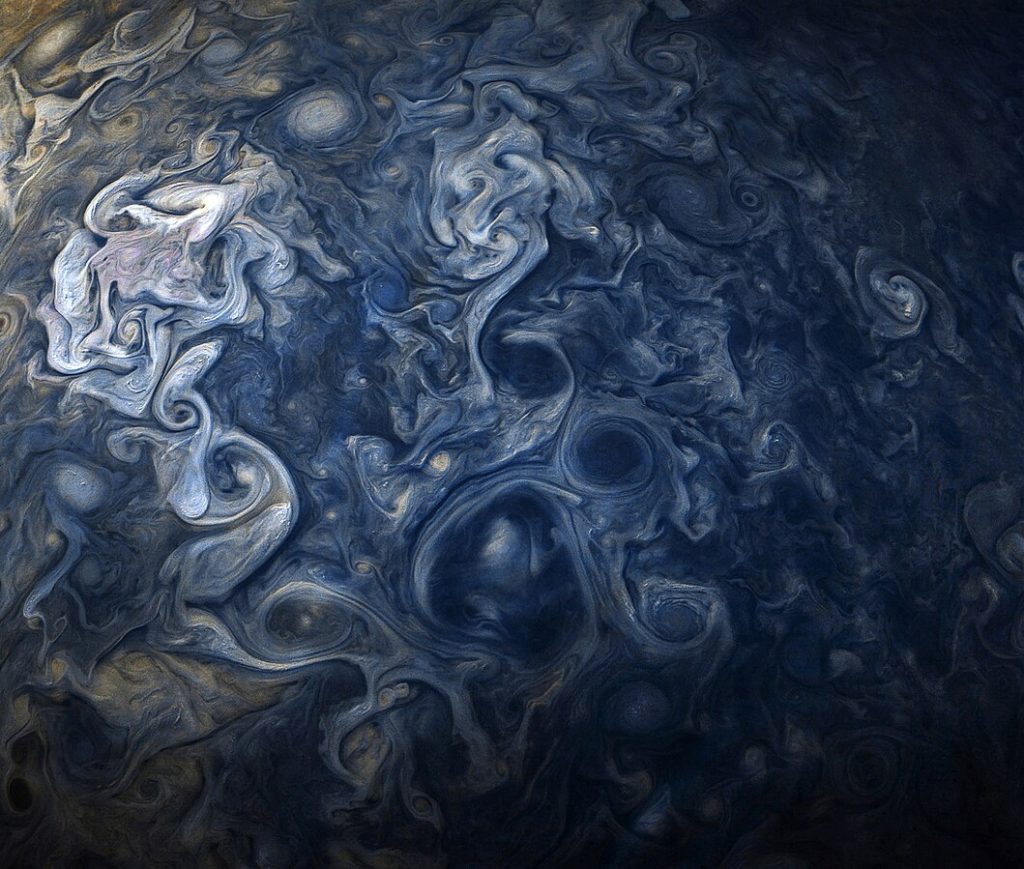
Blue Jovian clouds on Jupiter, taken from 11,747 miles (18,906 km) away by the Juno spacecraft. Jupiter Blues by NASA/JPL-Caltech/SwRI/MSSS/Gerald Eichstadt/Sean Doran is in the public domain.
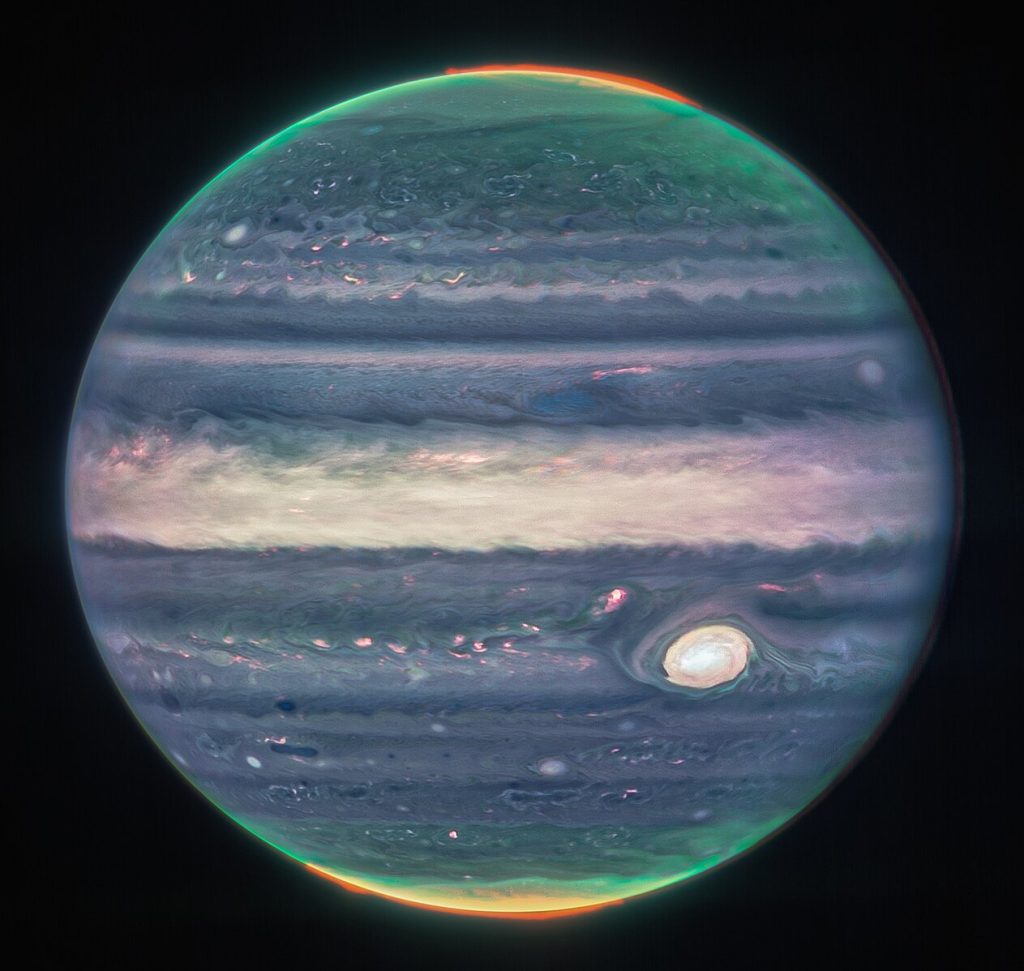
Jupiter by James Webb Space Telescope. The image is a composite, and shows Jupiter in enhanced color, featuring the planet’s turbulent Great Red Spot, which appears white here. The planet is striated with swirling horizontal stripes of neon turquoise, periwinkle, light pink, and cream. The stripes interact and mix at their edges like cream in coffee. Along both of the poles, the planet glows in turquoise. Bright orange auroras glow just above the planet’s surface at both poles. Jupiter Showcases Auroras by NASA is in the public domain.
Jupiter also emits more heat than it receives from the Sun, a legacy of its formation and ongoing gravitational contraction, along with internal differentiation, that provides a persistent internal energy source. This heat drives deep convective currents in the planet’s interior, which in turn power the winds and storms we observe at and above the cloud‑tops. Combined with Jupiter’s immense size and mass, this internal energy ensures the planet is never static, its appearance is constantly evolving in both subtle and dramatic ways. Even minor shifts in its cloud bands or storm colours are closely monitored by astronomers, because they offer valuable clues about the processes occurring far beneath the visible layers.33: Go to reference 33 at the end of the page
The planet’s magnetic field is the strongest of any planet in the Solar System, extending millions of kilometers into space and shaping the environment around it. Charged particles trapped within this field form intense radiation belts, creating a hazardous region for spacecraft and electronics. These belts, along with the planet’s faint ring system, highlight Jupiter’s vast influence, demonstrating that it is not only a dominant gravitational presence but also a formidable electromagnetic force.34: Go to reference 34 at the end of the page
And stretching over its poles, Jupiter boasts permanent auroras that are brighter and more energetic than anything on Earth. These auroras are driven not only by the solar wind but also by Io, the volcanic moon whose eruptions inject charged particles into Jupiter’s colossal magnetic field.35: Go to reference 35 at the end of the page
H ~90%, He ~10%, trace CH4, NH3, H2O, other volatiles
The Galilean moons
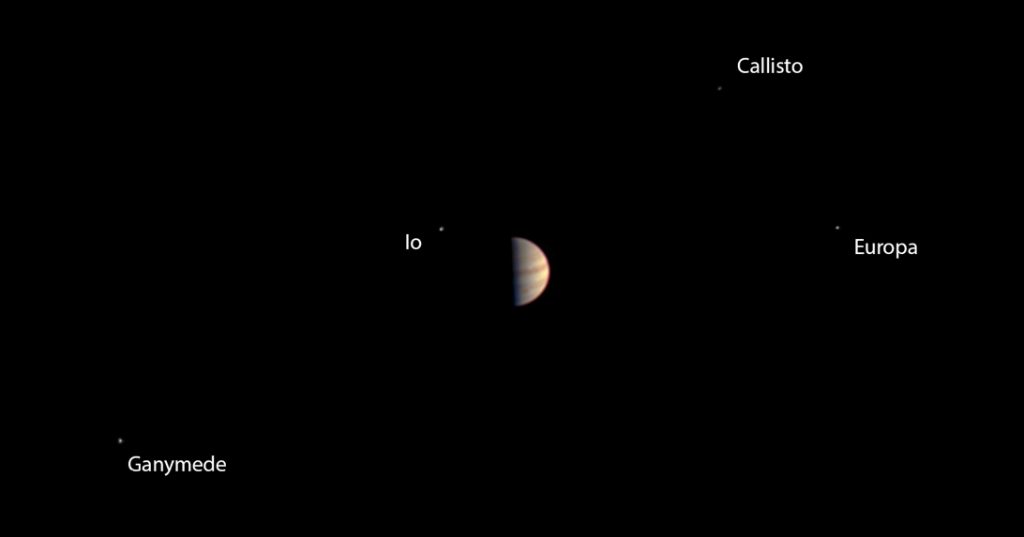
This is the final view taken by the JunoCam instrument on NASA’s Juno spacecraft before Juno’s instruments were powered down in preparation for orbit insertion. Juno obtained this color view on June 29, 2016, at a distance of 3.3 million miles (5.3 million kilometers) from Jupiter. Juno Closes in on Jupiter annotated by NASA/JPL-Caltech/SwRI/MSSS is in the public domain.
Jupiter has almost 100 moons, but the four biggest, Io, Europa, Ganymede, and Callisto, are the ones most people talk about. They are called the Galilean moons because Galileo Galilei was the first to observe them in 1610, marking the first time anyone had seen moons orbiting another planet and forever changing our understanding of the Solar System.37: Go to reference 37 at the end of the page These four moons are not just large, they are fascinating worlds in their own right. Each has a unique environment and set of features, from volcanic activity to hidden oceans, that make them compelling targets for scientific study and future exploration. While Jupiter itself is a gas giant with no solid surface, these satellites offer tangible landscapes and intriguing possibilities for understanding how moons form, how they interact with their parent planet, and even where life might exist beyond Earth.
Before diving into each of the four individually, it is worth noting that the Galilean moons are just the tip of the iceberg. Jupiter’s smaller moons, though less famous, contribute to a complex system of orbits and gravitational interactions, shaping the planet’s rings and influencing the dynamics of the larger moons. Together, the entire Jovian satellite system forms one of the most diverse and captivating collections of worlds in the Solar System.
Io: A World Scorched by Gravity
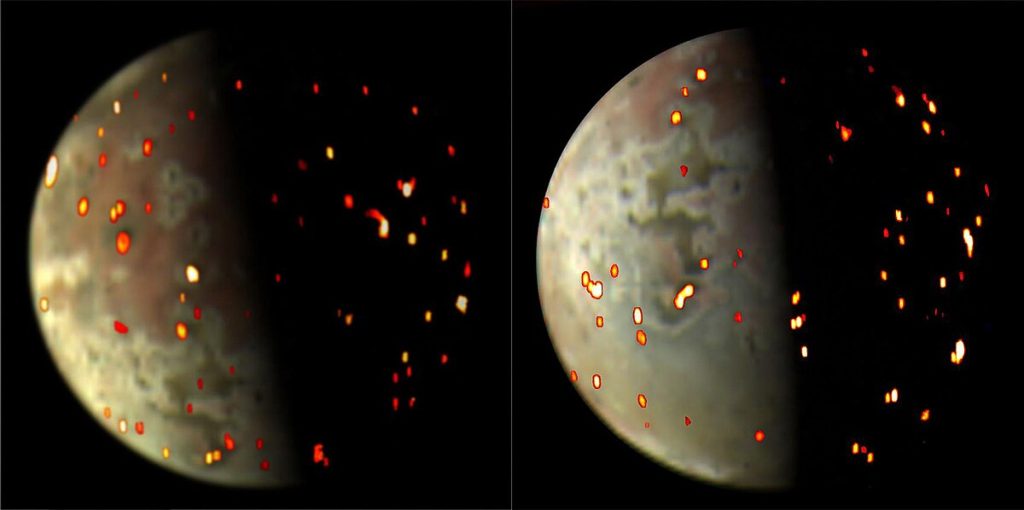
Io is the innermost of Jupiter’s four largest moons, orbiting the planet at about 422,000 kilometres.38: Go to reference 38 at the end of the page Its surface is covered with hundreds of active volcanoes, some erupting fountains of lava dozens of kilometres high, making it a place of constant change and violent beauty. 🤘
The intense volcanic activity is primarily driven by tidal heating. Jupiter’s immense gravity exerts strong tidal forces on the moon, flexing its interior as it orbits. These gravitational tugs generate enormous frictional heat, which melts rock into magma and fuels the continuous eruptions observed across its surface. In fact, the heat from this tidal flexing makes Io more volcanically active than any other known object in the Solar System, including Earth.
The moon’s surface bursts with a kaleidoscope of colors, from yellow and orange to red and green, created by deposits of sulfur and sulfur dioxide. Vast plains, mountains taller than those on Earth, and lava lakes give the moon a surreal, almost alien landscape. These features are constantly reshaped by volcanic eruptions, meaning the surface of Io is remarkably young compared to most other moons and planets. Craters are scarce because eruptions continuously cover older terrain with fresh lava and volcanic deposits.39: Go to reference 39 at the end of the page
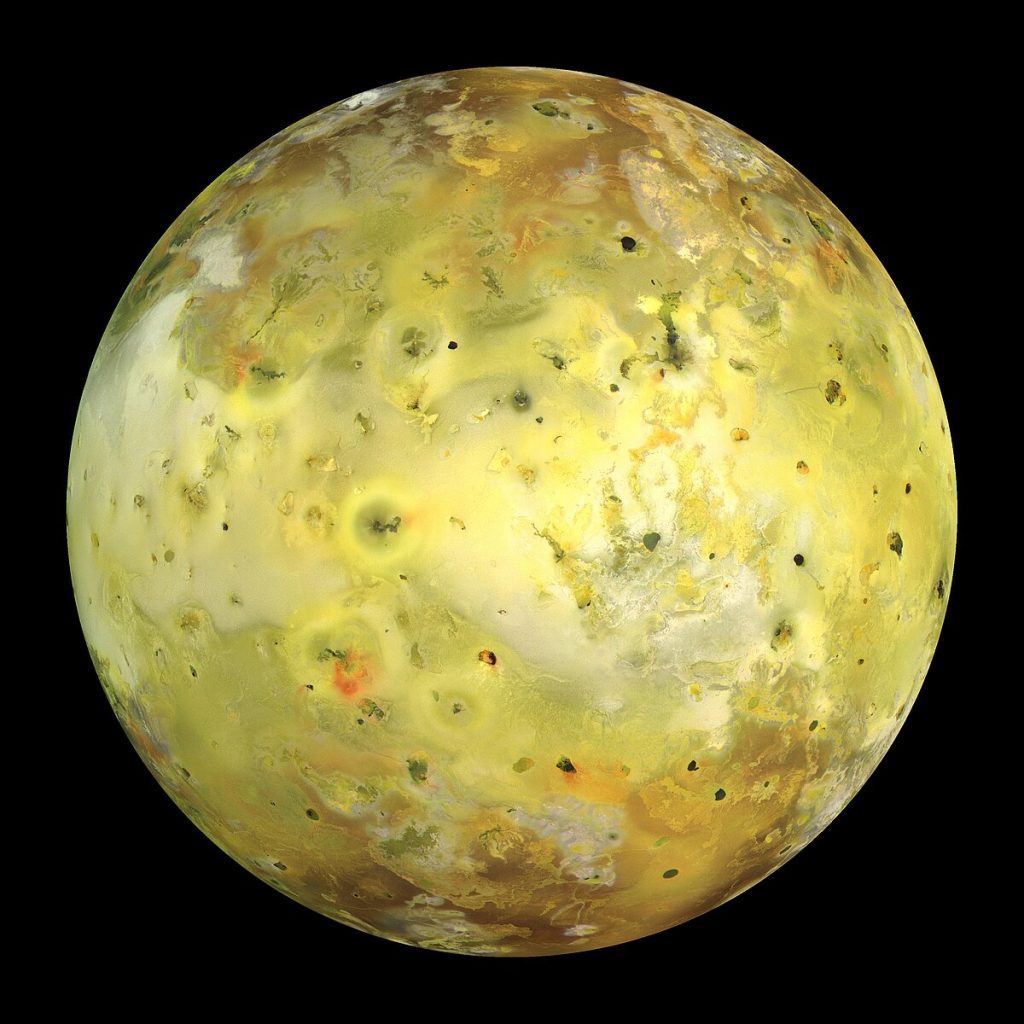
NASA’s Galileo spacecraft acquired its highest resolution images of Jupiter’s moon Io on 3 July 1999 during its closest pass to Io since orbit insertion in late 1995. This color mosaic uses the near-infrared, green and violet filters (slightly more than the visible range) of the spacecraft’s camera and approximates what the human eye would see. Io highest resolution true colo by NASA/JPL-Caltech/SwRI/MSSS is in the public domain.
YETI SIDEBAR
On Earth’s Moon, our planet’s gravitational pull causes only slight flexing of the rocky crust, just enough to have gradually slowed the Moon’s rotation until it became tidally locked. Today, this effect is subtle, producing little more than minor internal stresses. The Moon’s diameter is about 3,474 kilometres, and it orbits Earth at an average distance of roughly 384,000 kilometres, a separation that weakens the tidal stretching.40: Go to reference 40 at the end of the page
Io, by contrast, is slightly larger, measuring approximately 3,642 kilometres across, yet its environment is far more extreme. It orbits Jupiter at just 421,000 kilometres, a distance surprisingly close to the Earth–Moon separation. The key difference is Jupiter’s immense mass, over 300 times greater than Earth’s. Combined with the orbital tugs from nearby Europa and Ganymede, Io is stretched and squeezed so violently that its rocky surface shifts by more than 100 metres. This relentless flexing generates immense amounts of internal heat, fueling constant volcanic eruptions and making Io the most geologically active world in the Solar System.41: Go to reference 41 at the end of the page
Composite depicting volcanic activity on Io, generated using both visible light and infrared data collected by NASA’s Juno spacecraft during flybys. Io Volcano Activity by NASA/JPL-Caltech/SwRI/ASI/INAF/JIRAM is in the public domain.
Io’s intense volcanic activity has significant effects on the Jupiter system. The moon ejects substantial amounts of material into space, including sulfur and sodium ions, which interact with Jupiter’s powerful magnetic field. These interactions contribute to the formation of the Io plasma torus, a doughnut-shaped ring of ionized particles that co-rotates with Jupiter’s magnetic field. This plasma torus plays a crucial role in shaping Jupiter’s magnetosphere and radiation environment.42: Go to reference 42 at the end of the page
Additionally, Io’s volcanic plumes can create transient, localized atmospheres. These atmospheres are primarily composed of sulfur dioxide and are sustained by the continuous volcanic outgassing. The dynamics of these temporary atmospheres are influenced by factors such as volcanic activity, sublimation, and interactions with Jupiter’s magnetosphere.43: Go to reference 43 at the end of the page
Despite its extreme environment, Io is a natural laboratory for studying planetary geology and tidal heating. Missions like Galileo and Juno have provided detailed images and data, revealing how a small moon can generate enough internal heat to remain volcanically active over billions of years. For scientists, Io offers a glimpse into processes that could occur on exoplanets and moons beyond our Solar System, making it a key subject in the search to understand how worlds evolve under intense gravitational forces.
Europa: Jupiter’s Hidden Ocean
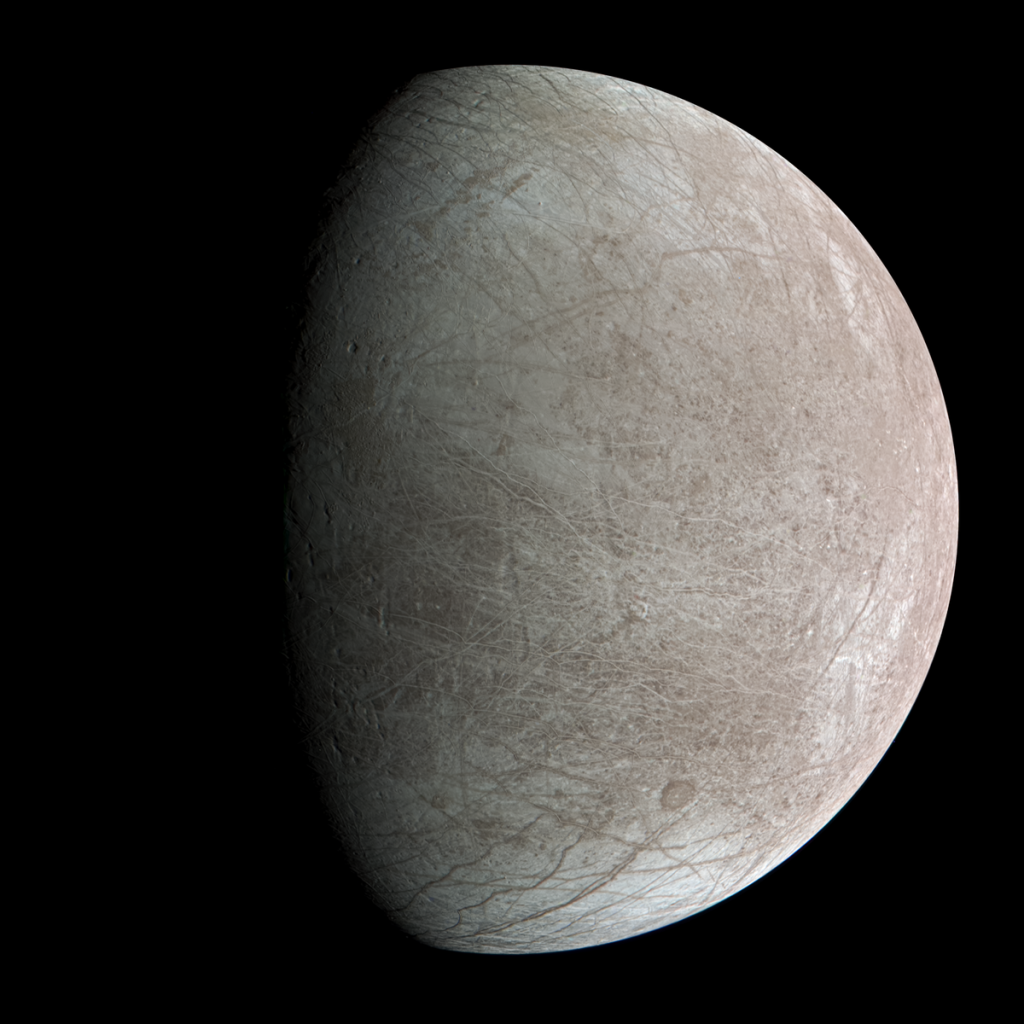
Europa in natural color taken by the space probe Juno. Europa in natural color by NASA/JPL-Caltech/SwRI/MSSS/Kevin M. Gill is licensed under CC BY 3.0.
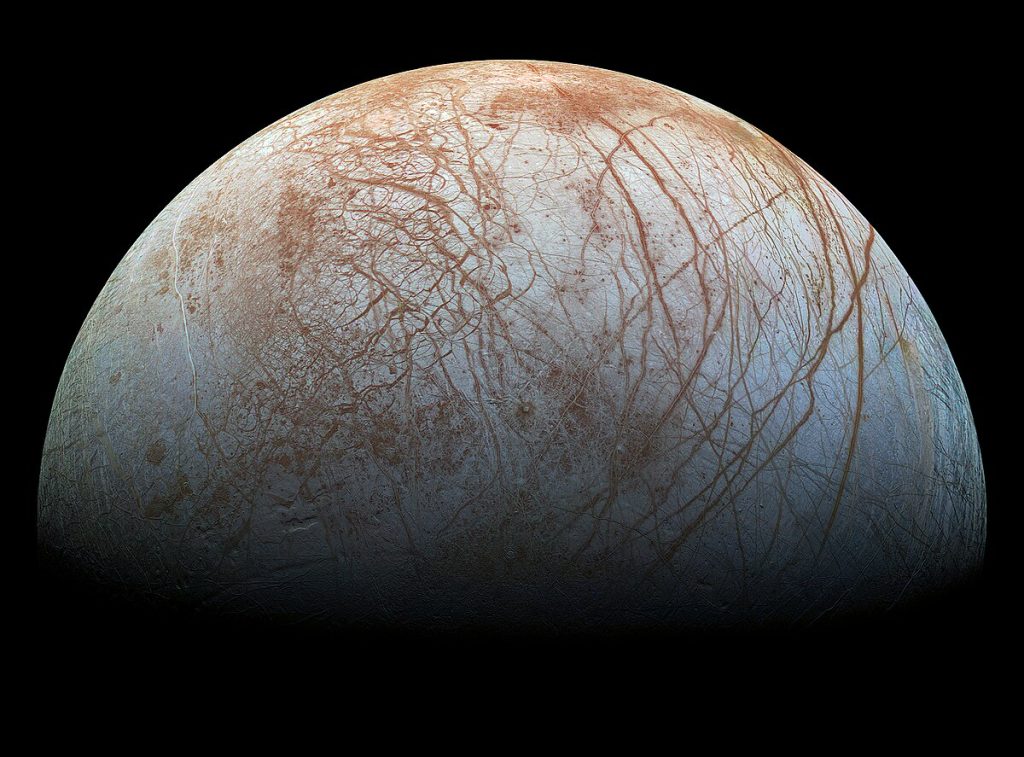
Europa is slightly smaller than Earth’s Moon, with an equatorial diameter of about 3,100 kilometers, making it approximately 90% the size of our Moon.44: Go to reference 44 at the end of the page Despite its size, Europa has garnered significant attention due to the compelling evidence suggesting a vast ocean beneath its icy crust. Its surface is smooth and bright, crisscrossed with long fractures and streaks, indicating that the ice shell is constantly shifting and reshaping itself. These features give Europa a striking, almost frozen-network appearance, unlike any other moon in the Solar System. Europa orbits Jupiter at an average distance of about 670,900 kilometers, keeping it firmly within the giant planet’s powerful gravitational influence.45: Go to reference 45 at the end of the page
Beneath the ice, scientists believe there is a global ocean of liquid water, kept warm by tidal heating caused by Jupiter’s gravitational pull. As the moon orbits the gas giant, the varying gravitational forces flex its interior, generating heat that prevents the ocean from freezing solid. This hidden ocean could be more than twice the volume of all Earth’s oceans combined, making this moon a prime candidate in the search for extraterrestrial life.46: Go to reference 46 at the end of the page
Europa’s relatively young surface, with very few impact craters, indicates that geological activity is ongoing. Ice may be slowly drifting and breaking apart, sometimes forming ridges or resurfaced plains, while occasional geysers of water vapor have been observed erupting from the surface. These plumes provide a rare opportunity to study the moon’s subsurface ocean without drilling through kilometers of ice.47: Go to reference 47 at the end of the page
The moon’s magnetic environment also adds to its intrigue. Europa has a weak induced magnetic field, which suggests that the subsurface ocean contains saltwater capable of conducting electricity. This magnetic interaction with Jupiter’s own enormous magnetic field may help create an energy source that could support simple life forms in the ocean below.48: Go to reference 48 at the end of the page
For scientists, Europa represents a tantalizing mix of familiarity and alienness. Its icy shell and hidden ocean make it both a scientific laboratory and a potential haven for life, and missions such as NASA’s Europa Clipper aim to explore these mysteries in detail. Europa shows how a small moon can hold enormous secrets beneath a deceptively calm surface.49: Go to reference 49 at the end of the page
Retouched mosaic of Jupiter’s moon Europa, showing the surface geology in realistic color. Realistic color Europa mosaic edited by NASA / Jet Propulsion Lab-Caltech / SETI Institute is in the public domain.
Ganymede: The Magnetic Giant
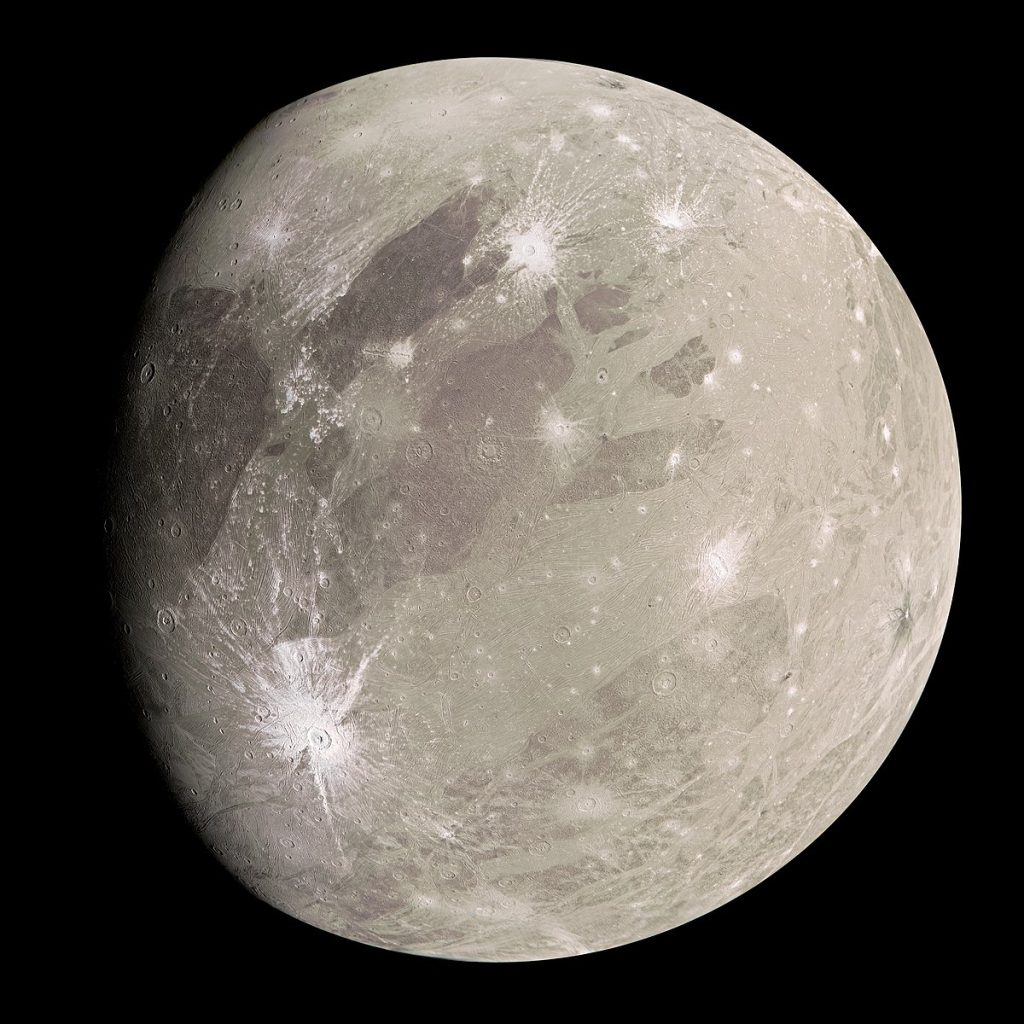
Orbiting Jupiter at an average distance of about 1,070,000 kilometers, Ganymede stands out as the largest moon in the Solar System, surpassing even the planet Mercury in size. However, it is less dense (1.94 g/cm3 compared to Mercury’s 5.43 g/cm3) due to its composition of roughly equal parts rock and water ice.50: Go to reference 50 at the end of the page Its sheer scale is remarkable, yet what makes it truly fascinating is the complexity of its surface, shaped over billions of years of geological change. Bright bands of ridges and grooves cut across darker, heavily cratered terrain, revealing a long history of tectonic activity and resurfacing that has continually reshaped the moon’s face.51: Go to reference 51 at the end of the page
Unlike most moons, Ganymede possesses its own intrinsic magnetic field, a feature more commonly associated with planets. This magnetic field generates auroras at its poles and interacts with Jupiter’s immense magnetosphere, creating a unique and complex environment. Scientists believe the magnetic field is produced by a liquid iron-nickel core, similar to the mechanism that drives Earth’s magnetism.52: Go to reference 52 at the end of the page
Ganymede photographed by Juno in 2021. Ganymede by NASA/JPL-Caltech/SwRI/MSSS/Kevin M. Gill is licensed under CC BY 2.0.
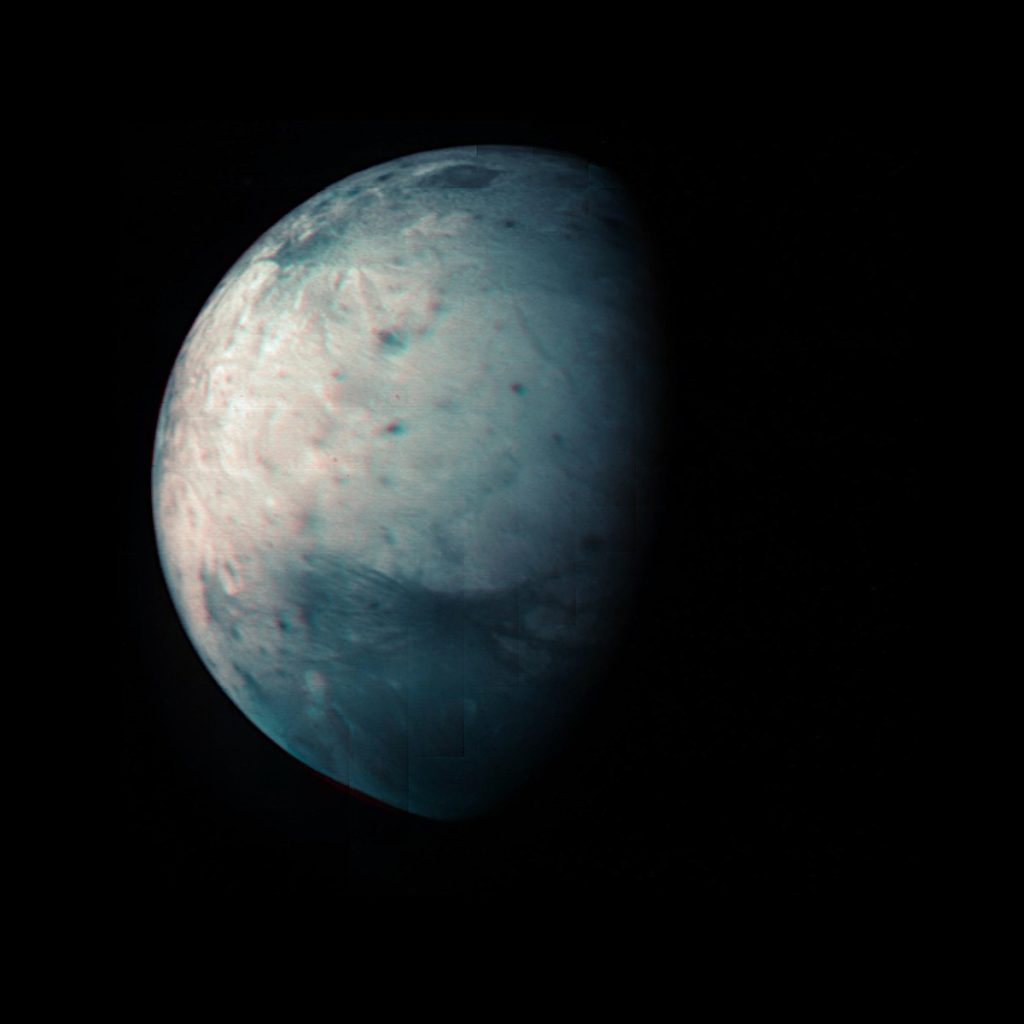
Infrared view of Ganymede, obtained by the Jovian Infrared Auroral Mapper (JIRAM) instrument aboard NASA’s Juno spacecraft during its July 20th, 2021, flyby. JIRAM “sees” in infrared light not visible to the human eye, providing information on Ganymede’s icy shell and the composition of the ocean of liquid water beneath. Ganymede in Infared by NASA/JPL-Caltech/SwRI/ASI/INAF/JIRAM is in the public domain.
Beneath its icy exterior, Ganymede is also thought to harbor a subsurface ocean sandwiched between layers of ice. While not as accessible as Europa’s ocean, it could still contain more water than all of Earth’s oceans combined. This hidden ocean raises the possibility that Ganymede could support life in some form or at least provide clues about how large moons evolve and maintain liquid water over billions of years.53: Go to reference 53 at the end of the page
The surface also shows evidence of past tectonic and possibly cryovolcanic activity. Grooved terrain indicates that the ice shell has been stretched and fractured, while older dark regions preserve the record of ancient impacts.54: Go to reference 54 at the end of the page This geological diversity makes Ganymede an ideal target for understanding the processes that shape large icy moons.
Ganymede has been observed and studied by spacecraft including Voyager, Galileo, and most recently Juno, with ESA’s upcoming JUICE mission scheduled to enter orbit around the moon in the 2030s.55: Go to reference 55 at the end of the page These missions aim to explore its magnetic field, ice shell, and potential subsurface ocean, offering a window into one of the most extraordinary moons in the Solar System.
Callisto: History Written in Ice
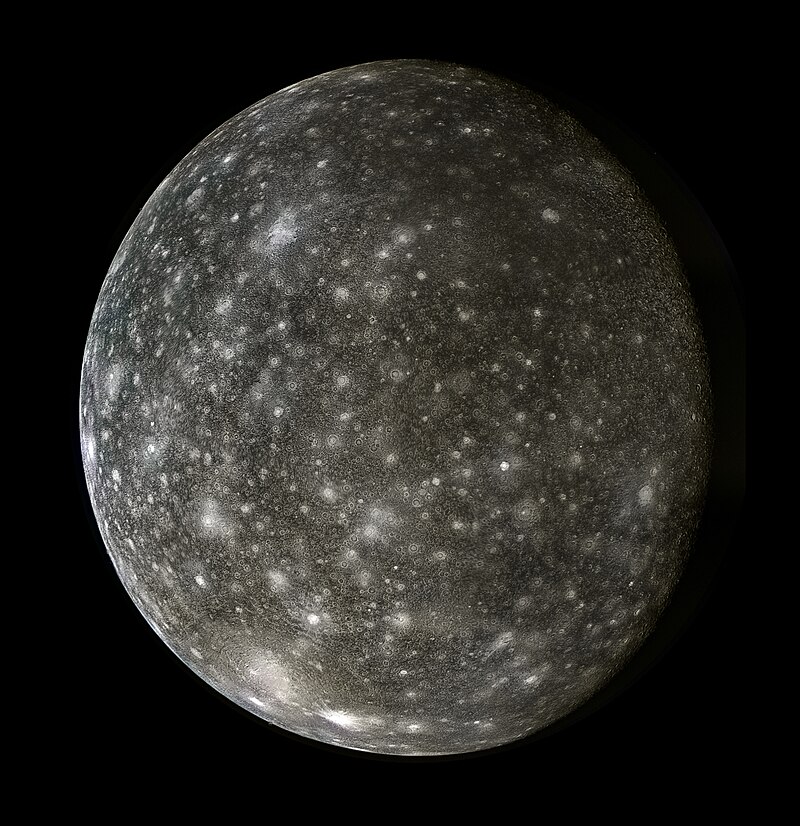
Callisto processed using low resolution (wide angle) orange, green, and blue filtered images colorizing higher resolution (narrow angle) unfiltered images taken by Voyager 2 on July 8 1979. Callisto by NASA/JPL-Caltech/Kevin M. Gill is licensed under CC BY 2.0.
Callisto is the most distant of Jupiter’s four Galilean moons, orbiting the planet at nearly 1.9 million kilometers.56: Go to reference 56 at the end of the page Unlike its more geologically active siblings, Callisto boasts a heavily cratered and ancient surface, largely unchanged for billions of years. This makes it a frozen time capsule, preserving the history of impacts from the early Solar System and offering scientists a glimpse into the past.
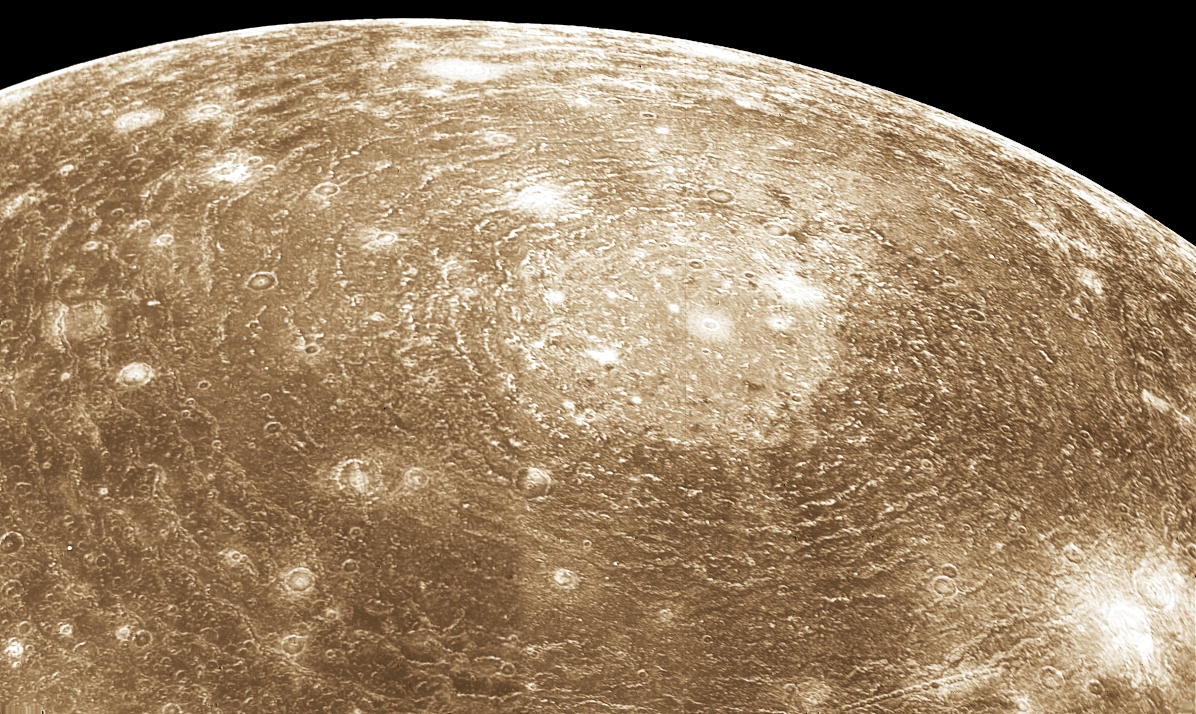
The moon’s surface is a patchwork of bright and dark regions, riddled with craters of all sizes. The largest, Valhalla, spans over 3,800 kilometers, making it one of the most impressive impact structures in the Solar System.57: Go to reference 57 at the end of the page Unlike Io or Europa, Callisto shows little evidence of tectonic or volcanic activity, suggesting that it has been geologically quiet for much of its history.
Beneath its icy crust, Callisto is thought to host a subsurface ocean, though it lies deeper and is less active than Europa’s or Ganymede’s. This ocean may still interact with the surface over long timescales, but the lack of tidal heating means the energy available for geological activity is minimal.58: Go to reference 58 at the end of the page Despite this, the presence of liquid water makes Callisto a subject of interest for understanding icy moons and their potential for habitability.
Callisto also lacks a significant magnetic field, unlike Ganymede, but it does experience induced fields from Jupiter’s magnetosphere.59: Go to reference 59 at the end of the page Its distance from the planet means it avoids the intense radiation that batters the inner moons, making it one of the safer destinations in the Jovian system for future spacecraft exploration.
For explorers and scientists alike, Callisto represents a quiet, ancient world. Its heavily cratered surface and frozen history contrast sharply with the fiery Io, the oceanic Europa, and the dynamic Ganymede, rounding out the diversity of Jupiter’s largest moons and highlighting the rich variety of worlds that orbit the giant planet.60: Go to reference 60 at the end of the page
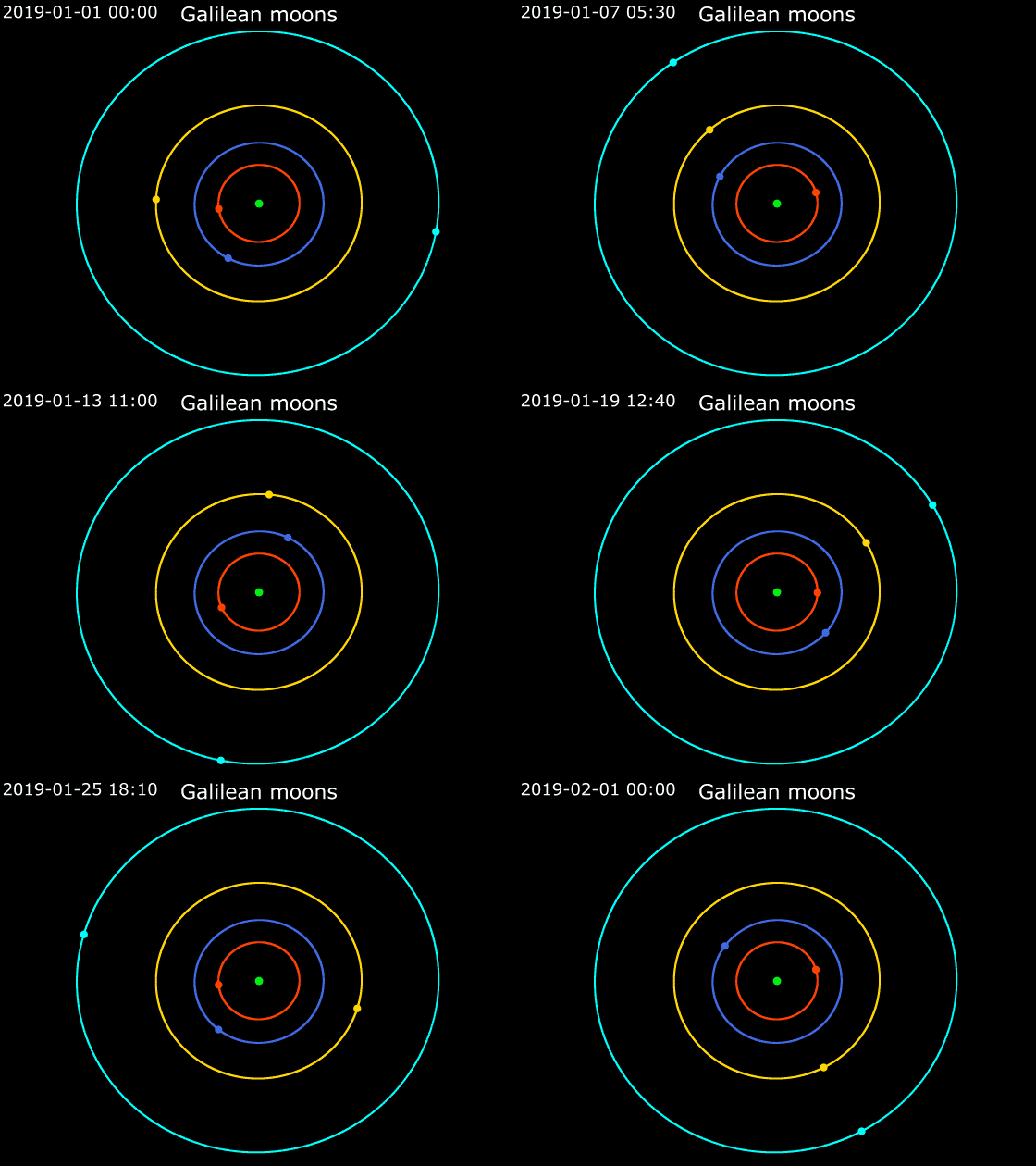
The inner three Galilean moons, Io, Europa, and Ganymede, are locked in a fascinating orbital pattern known as the Laplace resonance.61: Go to reference 61 at the end of the page In this arrangement, for every four orbits that Io completes, Europa completes two, and Ganymede completes one. This precise 4:2:1 ratio keeps their orbits slightly elliptical rather than perfectly circular, creating constant gravitational tugs that stretch and flex the moons as they orbit.
Galilean moons around Jupiter. Jupiter (green), Io (red), Europa (blue), Ganymede (yellow), and Callisto (light blue) Galilean moons around Jupiter by NASA/JPL- HORIZONS System is licensed under CC BY-SA 4.0.
This ongoing stretching generates intense tidal heating, particularly on Io, which drives its spectacular volcanic activity, and likely keeps a subsurface ocean liquid beneath Europa’s icy crust. Even Ganymede feels the effects, though to a lesser degree, which helps explain why it shows some signs of internal activity, despite its thick icy shell.
Jupiter’s fourth Galilean moon, Callisto, lies much farther out and does not participate in this resonance. Its orbit is comparatively stable and nearly circular, which means it experiences far less tidal heating. As a result, Callisto remains geologically quiet, a stark contrast to its more active inner siblings.
Saturn: Pearl of the Solar System
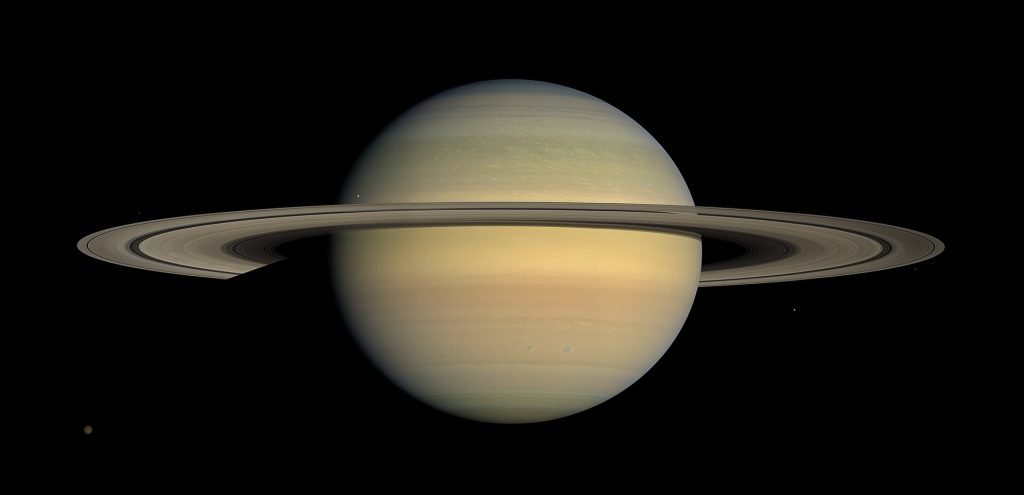
Saturn is one of the most recognisable planets in the Solar System, famed for its elegant rings that shimmer like a cosmic jewel.62: Go to reference 62 at the end of the page Slightly smaller than Jupiter, Saturn is still a gas giant of immense proportions, composed predominantly of hydrogen and helium. Despite its size, Saturn has a remarkably low density, so low, that it would float in water (if a bath tub large enough existed). Like Jupiter, the planet’s rapid rotation, completing a spin in just over ten hours, causes it to bulge at the equator and flatten at the poles, giving it a distinctive oblate shape.
Natural colour view of Saturn created from images collected bu Cassini in 2009. Saturn during Equinox by NASA / JPL / Space Science Institute is in the public domain.
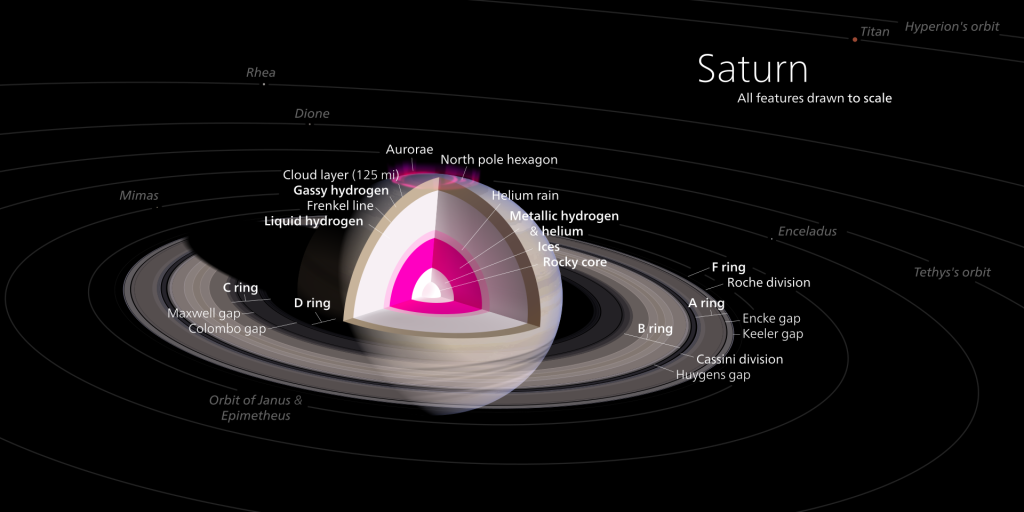
This detailed scientific diagram illustrates Saturn’s internal structure and surrounding features, all drawn to scale. The cross-section reveals the planet’s layered composition from its core outward: a rocky core at the center (shown in pink/magenta), surrounded by metallic hydrogen and helium layers, then liquid hydrogen, gaseous hydrogen, and finally a cloud layer at 125 millibars featuring auroras and a distinctive north pole hexagon.
Saturn’s famous ring system is prominently displayed, labeled from innermost to outermost: D ring, C ring (with Maxwell gap and Colombo gap), B ring, the Cassini Division (between B and A rings), A ring (with Encke gap and Keeler gap), F ring (with Roche division), and the more distant E ring.
Several of Saturn’s moons are labeled in their orbital positions around the planet, including Mimas, Enceladus, Tethys, Dione, Rhea, Titan, Hyperion, and the more distant Janus/Epimetheus. Hyperion’s orbit is specifically noted at the top right of the image. The entire scene is set against a black background, emphasizing the pale golden color of Saturn and the gray tones of its rings.
The planet’s rings are by far its most iconic feature.63: Go to reference 63 at the end of the page Composed of countless ice and rock particles ranging from tiny grains to house-sized chunks, the rings form complex structures and divisions that reflect both Saturn’s gravity and the influence of its many moons. Aside from their striking appearance, the rings are scientifically fascinating, offering insights into the processes of planetary formation and the dynamics of orbiting particles. Even faint gaps, like the Cassini Division, tell stories of moon-ring interactions that are still being studied today.
H ~96%, He ~3–4%, trace CH4, NH3, H2O, other volatiles
YETI SIDEBAR
Jupiter and Saturn are composed mostly of hydrogen and helium, just like the Sun. Jupiter is roughly 90% hydrogen and 10% helium by mass, while Saturn has a slightly higher proportion of hydrogen, around 96%, with helium making up 3–4%, plus trace amounts of methane, ammonia, water, and other volatiles. These compositions make both planets miniature versions of a star in terms of elemental makeup.65: Go to reference 65 at the end of the page
However, their masses are far too low to ignite nuclear fusion. Jupiter would need to be about 80 times more massive to become a star, while Saturn would need roughly 300 times its current mass. Even with all that hydrogen and helium, they remain gas giants, glowing only faintly from leftover heat, unlike the Sun, which continuously converts hydrogen into energy in its core.66: Go to reference 66 at the end of the page
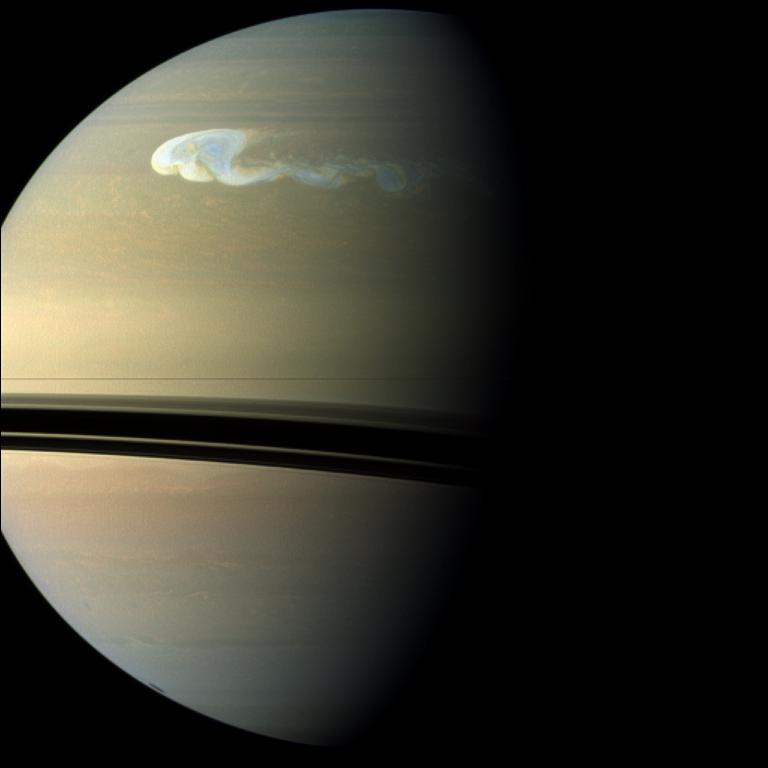
Saturn’s atmosphere is a layered, dynamic system of gases and clouds. Its bands of clouds, composed of ammonia (NH3), methane (MH4), and water vapor (H2O), stretch across the planet in subtle stripes, less vivid than Jupiter’s but no less fascinating. Winds can reach speeds of more than 1,800 kilometers per hour, whipping clouds into long, fast-moving bands and driving occasional massive storms, including the periodic “Great White Spot,” a storm that can grow large enough to be visible from Earth.67: Go to reference 67 at the end of the page The combination of rapid rotation and internal heat drives this continuous atmospheric turbulence.
The interior of Saturn holds further surprises. Beneath the visible clouds, the planet’s hydrogen becomes metallic under extreme pressures, conducting electricity and contributing to its magnetic field. Like Jupiter, helium rain occurs deep within Saturn, with helium condensing into droplets and falling through the liquid metallic hydrogen.68: Go to reference 68 at the end of the page This process releases additional heat, which helps explain why Saturn emits more energy than it receives from the Sun, keeping its atmosphere active and dynamic.
Saturn’s Great White Spot storm of 2010-2011, pictured on December 24, 2010 by the Cassini spacecraft. Saturn Storm December 2010 by NASA/JPL-Caltech/SSI is in the public domain.
Shine bright like a diamond
Deep within Saturn’s atmosphere, extreme pressure and temperatures transform simple molecules into exotic forms. Methane (CH4) in the upper atmosphere is broken down by lightning and UV radiation, producing soot-like carbon particles. As these carbon particles fall deeper into the atmosphere, the immense pressure compresses them into graphite and eventually into crystalline diamonds. These diamonds then continue to sink toward the planet’s interior, forming literal “diamond rain.”69: Go to reference 69 at the end of the page
Estimates suggest the diamonds could be centimetres to metres in size, creating showers of solid carbon within the layers of Saturn. While we can’t see this directly, laboratory experiments simulating the high-pressure conditions of gas giants support the idea, and models predict that both Saturn and Jupiter could be raining diamonds continuously. This phenomenon highlights just how alien and extreme conditions can be on gas giants, far beyond anything we experience on Earth.
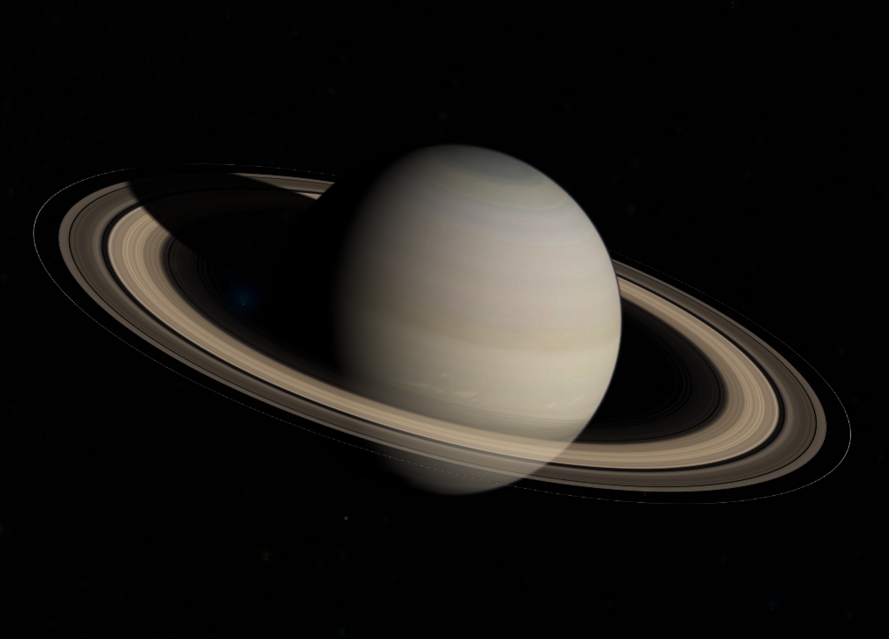
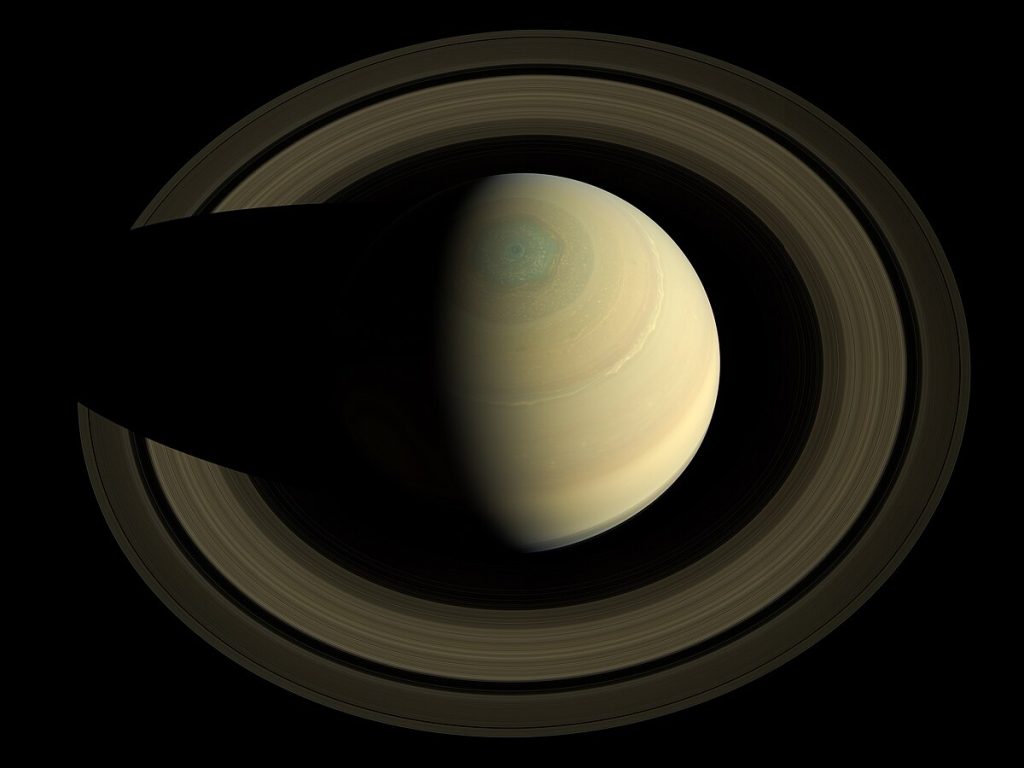
A swing high above Saturn by NASA’s Cassini spacecraft revealed this stately view of the golden-hued planet and its main rings. The view is in natural color, as human eyes would have seen it. This mosaic was made from 36 images in three color filters obtained by Cassini’s imaging science subsystem on Oct. 10, 2013. Top view of the rings of Saturn by Cassini by NASA/JPL-Caltech/SSI/Cornell is in the public domain.
Saturn’s magnetic field, though weaker than Jupiter’s, remains powerful and extends millions of kilometres into space. It traps charged particles in radiation belts and shapes a vast magnetosphere that interacts with the solar wind to produce bright auroras at the poles. These auroras, visible in ultraviolet light, are driven by both solar wind activity and interactions with charged particles from Saturn’s rings and moons.70: Go to reference 70 at the end of the page This reveals the scale and complexity of the planet’s electromagnetic environment.
From a distance, Saturn’s calm, pale-yellow appearance conceals the turbulence of its atmosphere and the energy generated deep within. Its famous rings display intricate structure, while storms and high-speed winds continue to reshape the upper cloud layers. Beneath its tranquil exterior, Saturn remains a highly active world of gas, heat, and motion.
I put a hex(agon) on you
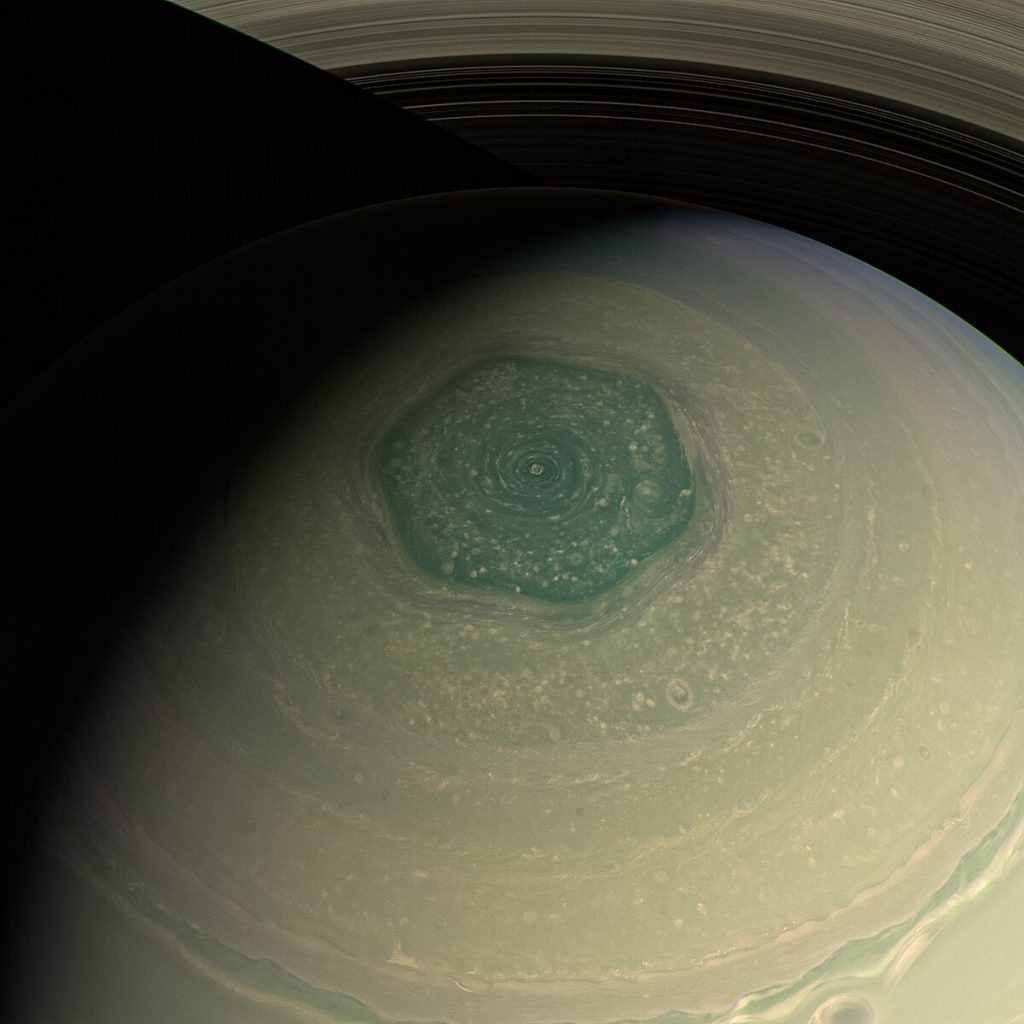
Images of Saturn taken by Cassini on July 24 2013. Saturn by NASA/JPL-Caltech/SSI/CICLOPS/Kevin M. Gill is licensed under CC BY 2.0.
Saturn’s north pole is home to one of the Solar System’s most unusual atmospheric features: a massive, six-sided jet stream known as the hexagon. Discovered by the Voyager spacecraft in the early 1980s and later imaged in detail by Cassini, the hexagon spans roughly 30,000 kilometres across, large enough to fit nearly four Earths inside. Unlike typical circular storms, this jet stream maintains a remarkably precise six-sided shape, swirling at wind speeds of up to 320 kilometres per hour.71: Go to reference 71 at the end of the page
The origin of the hexagon is still a subject of study, but scientists believe it results from differences in wind speeds at various latitudes, creating a stable standing wave pattern in Saturn’s atmosphere. The feature has persisted for decades, and possibly much longer, making it one of the most enduring and intriguing atmospheric phenomena in the Solar System. Its strange geometric perfection adds another layer of mystery to a planet already full of surprises.
Exploring Saturn
Modern exploration of Saturn began in the late 1970s, shortly after the pioneering missions to Jupiter. NASA’s Pioneer 11 was the first spacecraft to visit Saturn in 1979, following its Jupiter flyby, and it provided humanity with the first close-up images of the planet, its rings, and several of its moons. The Voyager missions followed in the early 1980s, with Voyager 1 passing Saturn in 1980 and Voyager 2 in 1981. These flybys revealed the complex structure of Saturn’s rings, discovered new moons, and captured detailed images of Titan, Saturn’s largest moon, hinting at its thick, nitrogen-rich atmosphere.
In 2004, the Cassini-Huygens mission marked a new era of Saturn exploration.72: Go to reference 72 at the end of the page Cassini entered orbit around the planet, conducting a 13-year study of Saturn, its rings, and its moons. The Huygens probe.73: Go to reference 73 at the end of the page landed on Titan in 2005, providing the first direct observations of its surface and liquid methane lakes. Cassini also investigated Enceladus, discovering active cryovolcanism and a global subsurface ocean, making it one of the most intriguing targets for astrobiology in the solar system. The mission’s extended observations of Saturn’s seasonal changes and ring dynamics dramatically expanded our understanding of this iconic gas giant.
Other missions, such as New Horizons in 2007, performed flybys of Saturn on their way to Pluto, collecting additional information on the planet’s atmosphere, rings, and magnetosphere.
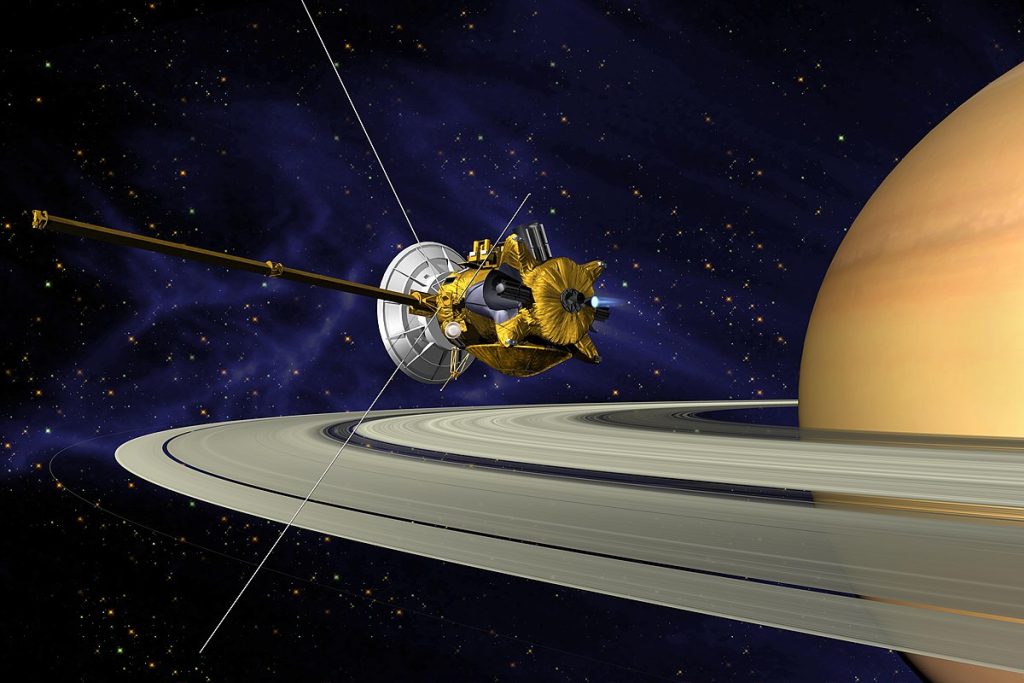
This is an artists concept of Cassini during the Saturn Orbit Insertion (SOI) maneuver, just after the main engine has begun firing. Cassini’s close proximity to the planet after the maneuver offers a unique opportunity to observe Saturn and its rings at extremely high resolution. Cassini Saturn Orbit Insertion by NASA/JPL is in the public domain.
Saturn is now a benchmark for studying giant planets and their satellite systems, and while no new orbiters are currently active, future mission concepts continue to explore its moons, particularly Titan and Enceladus, which remain top priorities in the search for habitable environments beyond Earth. Among the most promising future efforts are the Dragonfly mission to Titan,74: Go to reference 74 at the end of the page and concept studies such as E2T for Titan + Enceladus,75: Go to reference 75 at the end of the page reflecting the priority that space-agencies place on these moons as potential habitable environments.76: Go to reference 76 at the end of the page
The moons of Saturn
Saturn is accompanied by a staggering collection of moons, with over 80 confirmed satellites ranging from tiny irregular rocks to massive worlds larger than some planets.77: Go to reference 77 at the end of the page While the rings capture the eye, it is the moons that provide much of the planet’s dynamism and intrigue. Each moon interacts with Saturn’s gravity, magnetic field, and rings in unique ways, shaping the environment around the planet and offering scientists a wide range of natural laboratories for studying planetary processes.78: Go to reference 78 at the end of the page
Even beyond Titan and Enceladus, Saturn’s other moons play critical roles. They help maintain the structure and stability of the rings, influence each other’s orbits through gravitational interactions, and contribute charged particles to the planet’s magnetosphere. Together, the moons form a complex, interlinked system that is both beautiful and scientifically rich, setting the stage for a closer look at Saturn’s two most famous satellites.
Titan, the largest of Saturn’s moons, is a world unlike any other in the solar system. It boasts a dense, nitrogen-rich atmosphere thicker than Earth’s, making it the only moon with a substantial gaseous envelope. Methane and ethane form clouds, rain, and rivers on Titan, carving channels into its frozen surface and collecting in vast polar lakes.84: Go to reference 84 at the end of the page Cassini’s radar images revealed sprawling dune fields of organic material, frozen plains, and possible cryovolcanoes, painting a picture of a dynamic, evolving landscape that mimics Earth’s hydrologic cycle, but with methane in place of water.85: Go to reference 85 at the end of the page
Beneath this complex surface lies a hidden ocean of liquid water mixed with ammonia, extending hundreds of kilometres deep. This ocean, sandwiched between an icy crust and a rocky core, may provide a stable environment capable of supporting microbial life.86: Go to reference 86 at the end of the page The interactions between Titan’s subsurface ocean, frozen surface, and thick atmosphere create a multi-layered system of weather, geology, and chemistry that has no equal elsewhere. These processes make Titan a key target for understanding how prebiotic chemistry might emerge in cold, organic-rich environments.
Titan in true colour by NASA/JPL-Caltech/SSI/Kevin M. Gill is in the public domain.
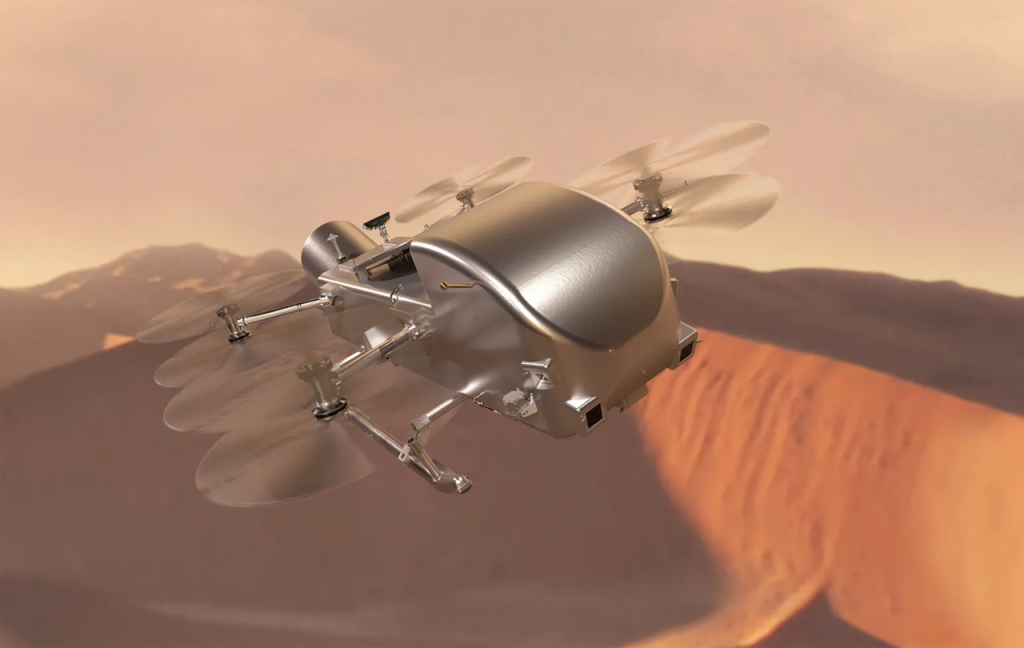
A rendered concept image of the NASA Dragonfly space probe. Dragonfly Concept Art by Steve Gribben/NASA/Johns Hopkins APL is in the public domain.
The upcoming Dragonfly mission, a rotorcraft drone set to launch in the 2030s, will explore Titan’s surface directly for the first time.87: Go to reference 87 at the end of the page Built to fly through its thick atmosphere, Dragonfly will move between sites such as organic dunes and ancient impact craters, analysing surface materials, weather patterns, and chemical composition to study how complex molecules form in environments rich in hydrocarbons and water ice.88: Go to reference 88 at the end of the page
By investigating these diverse landscapes, Dragonfly will help scientists understand how prebiotic chemistry might unfold on icy worlds. Titan’s blend of Earth-like weather, methane lakes, and organic compounds offers a glimpse into conditions that may have existed on early Earth, expanding our view of where and how life’s building blocks can emerge beyond our planet.89: Go to reference 89 at the end of the page
Enceladus: A Tiny Moon with Big Secrets
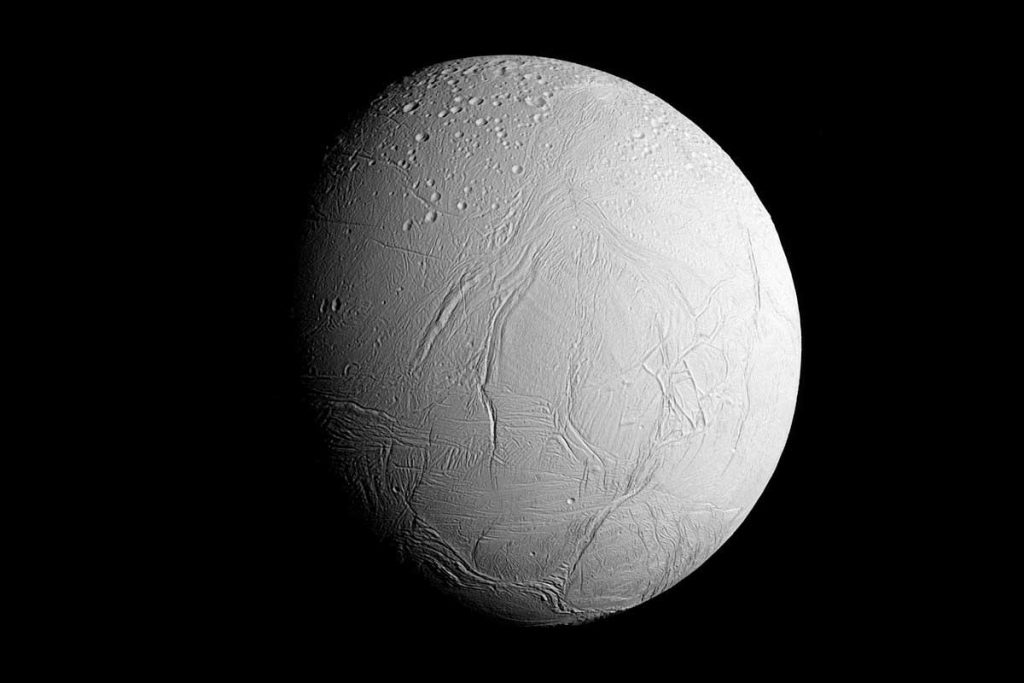
NASA’s Cassini spacecraft captured this view as it neared icy Enceladus for its closest-ever dive past the moon’s active south polar region. Approaching Enceladus by NASA/JPL is in the public domain.
Enceladus, though only about 500 kilometres across, is one of the most remarkable discoveries of modern planetary exploration. Right from the beginning its icy surface stood out, and scientists were struck by its extreme brightness, indicating fresh ice constantly resurfacing the moon. When the Cassini spacecraft first observed its surface, the real surprise came when it detected towering plumes of water vapour and ice particles erupting from fissures near Enceladus’s south pole, known as the “tiger stripes”. These fracture zones are where internal heat causes subsurface water to vent into space, feeding Saturn’s E ring and offering a glimpse into the moon’s hidden ocean beneath the crust.90: Go to reference 90 at the end of the page
Detailed analysis of these plumes revealed a complex chemical mix, including water vapour, salts, silica, and organic molecules, ingredients essential for life as we know it. For example, scientists found phosphorus in salt-rich ice grains ejected from Enceladus, underscoring that this tiny moon has more of life’s building blocks than once thought.91: Go to reference 91 at the end of the page
Evidence also suggests hydrothermal activity on the ocean floor, where seawater interacts with rock to release energy and nutrients, much like the deep-sea vents on Earth that host thriving ecosystems.92: Go to reference 92 at the end of the page These findings have positioned Enceladus as one of the most promising locations in the search for extraterrestrial habitability within our solar system.
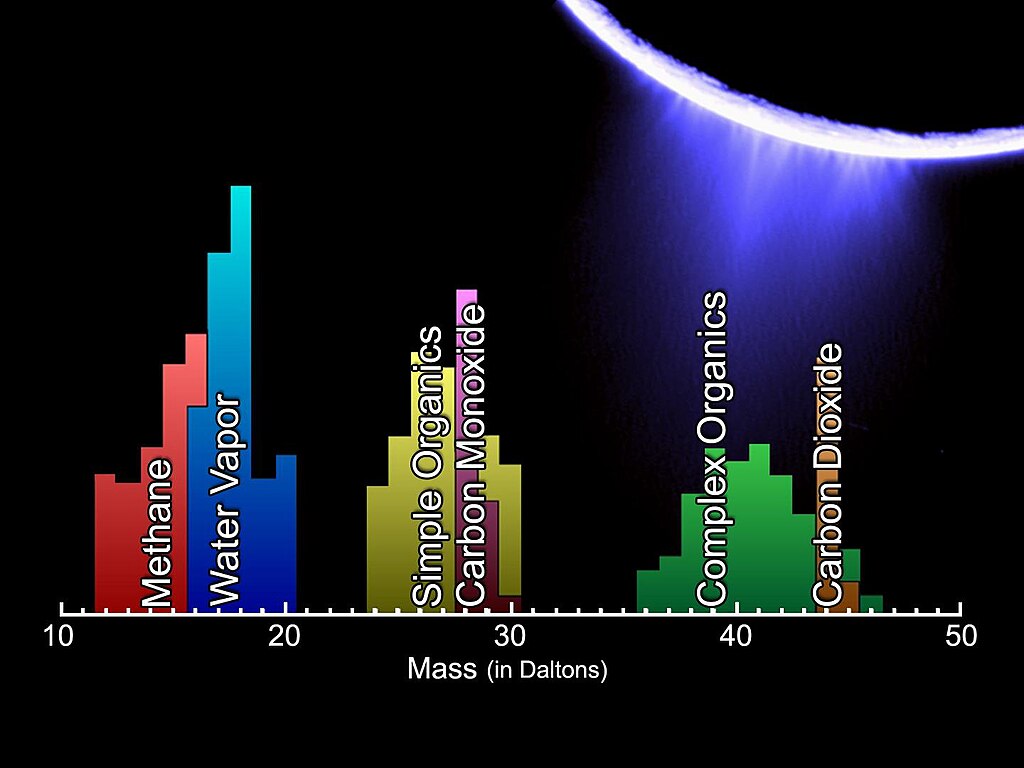
The chemical composition of Enceladus’s plumes. Enceladus plume molecule by NASA/JPL/SwRI is in the public domain.
Text description of image
This scientific chart displays mass spectrometry data of organic compounds detected in the plumes erupting from Saturn’s moon Enceladus. The background shows a striking image of Enceladus with bright blue-white jets of water vapor and ice particles shooting from its south polar region into space.
The bar graph plots molecular mass (measured in Daltons) on the x-axis ranging from 10 to 50, with frequency or abundance on the y-axis. Different categories of organic molecules are color-coded:
Methane (red bars) – appearing around 10-15 Daltons
Water Vapor (blue bars) – the tallest peaks, centered around 15-20 Daltons
Simple Organics (yellow bars) – distributed around 25-30 Daltons
Carbon Monoxide (olive/yellow bars) – appearing near 30 Daltons
Complex Organics (green bars) – found in the 35-45 Dalton range
Carbon Dioxide (small orange/brown bar) – appearing around 45 Daltons
The data suggests that Enceladus’s subsurface ocean contains not only water vapor but also a variety of organic molecules, from simple methane to more complex organic compounds, making it a key target in the search for potential extraterrestrial life.
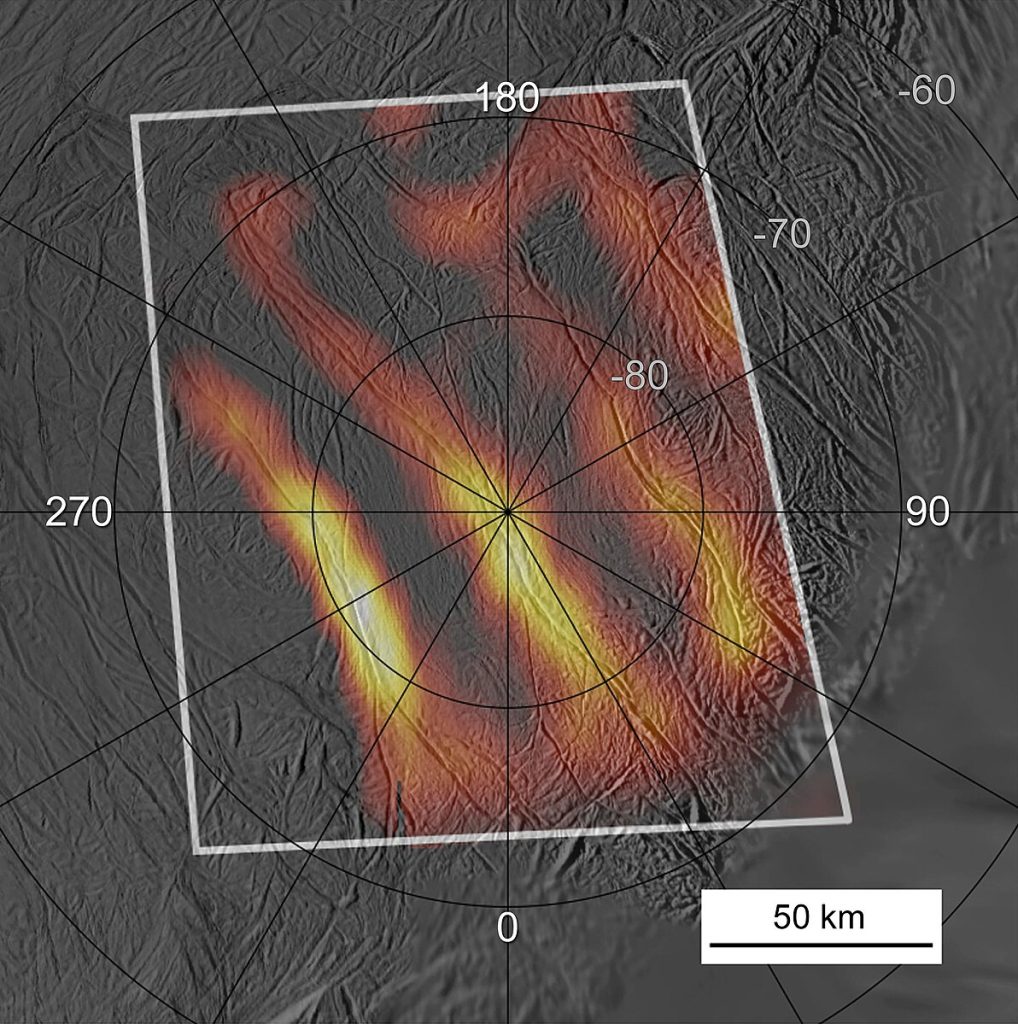
Thermal map of cracks near south pole of Enceladus, showing the “tiger stripes”. Jet Spots in Tiger Stripes by NASA/JPL/SwRI is in the public domain.
Cassini’s discoveries at Enceladus transformed our understanding of where habitable environments might exist beyond Earth. Before the mission, few scientists expected such a small, frozen moon to conceal a global ocean beneath its crust.93: Go to reference 93 at the end of the page The detection of organic compounds and heat-driven plumes revealed that Enceladus is geologically active and chemically rich, proving that liquid water and energy sources can persist even in the outer solar system. These insights reshaped planetary science, highlighting that life’s essential ingredients may be more widespread than once imagined.94: Go to reference 94 at the end of the page
Now, Enceladus stands at the forefront of astrobiological exploration. Its global ocean, internal heating, and continuous plumes make it a natural target for future missions seeking direct evidence of biological activity. Proposed orbiters and fly-through probes would sample the plumes to analyse their composition and search for complex organics or biosignatures.95: Go to reference 95 at the end of the page With its mix of water, energy, and organic chemistry, Enceladus remains one of the most compelling places to investigate how life might arise beyond Earth.
In conclusion
Jupiter and Saturn stand as twin titans of the Solar System, each commanding a realm of storms, rings, and remarkable moons. From Jupiter’s ceaseless tempests and volcanic Io to Saturn’s shimmering rings and the icy mysteries of Enceladus and Titan, these worlds remind us how diverse and dynamic our cosmic neighbourhood truly is. Together, they mark the border between the familiar warmth of the inner planets and the frozen frontier beyond, where the light of the Sun begins to fade and the unknown quietly waits.
Want to keep reading?
Finished this post but you still feel like reading? Check out one of my other space posts:
N: It’s either ~350 years or ~200 years. Giovanni Cassini describes a “a permanent [spot] which was often seen to return in the same place with the same size and shape”, but some believe this wasn’t the same as the current spot due to long gaps in the records and a study done in 2024. As of 1831, we believe the spot has been under continuous observation. So, it depends what info you trust more, I guess?
N: Earth also bulges at the equator and flattens at the poles, but since its rotation speed at the equator is about 1,670 kilometres per hour, compared to roughly 43,000 kilometres per hour on Jupiter, our planet’s equatorial bulge is far less pronounced.
R: Howard, S., Müller, S., & Helled, R. (2024, September 1). Evolution of Jupiter and Saturn with helium rain.Astronomy and Astrophysics, 689, Article A15. https://doi.org/10.1051/0004-6361/202450629
R: Cochrane, C.J., Vance, S.D., Castillo-Rogez, J.C., Styczinski, M.J., & Liuzzo, L. (2025). Stronger evidence of a subsurface ocean within Callisto from a multifrequency investigation of its induced magnetic field. AGU Advances, 6(1), e2024AV001237. https://doi.org/10.1029/2024AV001237
R: Khurana, K.K., Kivelson, M.G., Stevenson, D.J., Schubert, G., Russell, C.T., Walker, R.J., & Polanskey, C. (1998). Induced magnetic fields as evidence for subsurface oceans in Europa and Callisto. Nature, 395(6704), 777–780. https://doi.org/10.1038/27394
R: Mankovich, C. R., & Fuller, J. (2021). A diffuse core in Saturn revealed by ring seismology. Nature Astronomy, 5, 1103–1109. https://doi.org/10.1038/s41550-021-01448-3

 Jupiter, Io, and Europa by TheLostProbe (Screenshot), Askaniy Anpilogov + FarGetaNik / JaguarJack/Panterstruck (Textures) is licensed under CC BY-SA 4.0.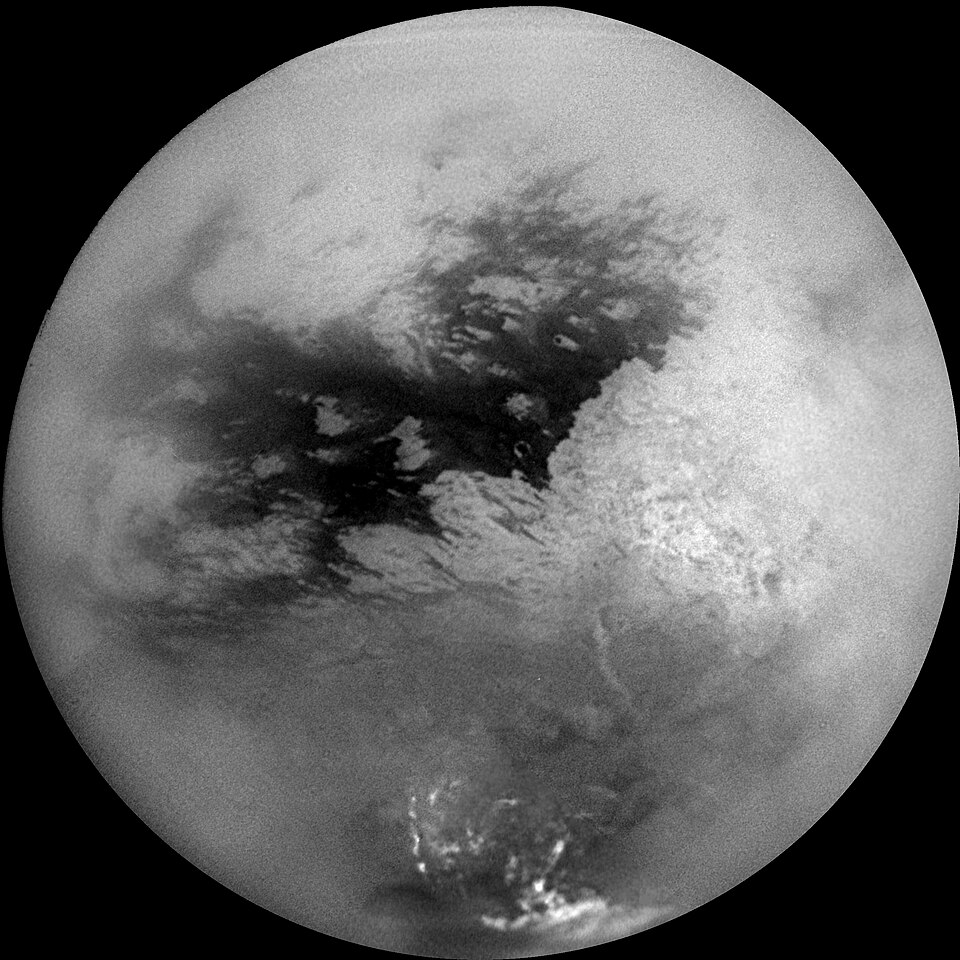


 R: Great Red Spot. (2025, October 12). In Wikipedia. https://en.wikipedia.org/wiki/Great_Red_Spot